Hits and Misses

Hits and Misses

Saturday, October 5, 2019

Wizards Metal Renew Polish

Wizards Metal Renew Polish  is new to me, but I must confess to all the enthusiasm of a convert.  Browsing the web, I came across Mark Harrell's video, "Maintaining your Saws" on his site Bad Axe Tool Works.  Given the outstanding reputation of these saws, I figured that if Mark Harrell recommended Wizards Metal Renew Polish for cleaning saw blades I should try it out. Reader, I love it.

You may well ask, What is it? I had no idea where to shop for Wizards Metal Renew Polish, so I took the easy route and ordered it from Amazon. It turns out to be part of a product line focused on car car. It's also available through chains like NAPA. It removes discoloration from a variety of metals, including steel, pewter, and brass (be warned, though:  if the brass is lacquered, it will also remove the lacquer). You can apply it with a cloth and then wipe it off and polish the metal with a clean cloth. Unlike some other polishes, it has an agreeable smell.

I tried it first on the blade of a heavily oxidized back saw, a Jackson, a secondary line for Disston. As I wanted to save the saw's etch if possible, I applied it generously and gently used a sanding block with 320 grit wet-or-dry paper. You can tell immediately that it's working because the cream-colored liquid starts turning brown. I wiped the blade off and repeated the process. The etch was long gone, it appeared, but the blade once more looked like steel. What I like about the result is that it retains the look of use and age. The steel doesn't look overly polished, just well-cared for.

With "well-cared for" in mind, I looked around for what else might illustrate how Wizards Metal Renew Polish works if I took some "Before" and "After" shots. And I realized that the table of my Delta band saw provided a relevant example.  I bought this band saw in non-working condition at least twenty-five years ago. I got it working and cleaned it up then, but I haven't touched the band saw's table since.  So here's the Before shot:


And here is the outcome after two applications of Wizards Metal Renew Polish followed by buffing the table with a cloth:


The table now is clean enough to reflect some of the colors of the polish's container. I personally don't want it any shinier, but if you do you might go on to use Wizards Metal Polish.

The label of Wizards Metal Renew Polish says nothing about corrosion protection. To protect the newly cleaned steel, I wiped it down with Break Free CLP, waited a few minutes, and then wiped it dry.


Monday, March 18, 2019

Another French Comment on Brexit

Given that Brexit is a mess with negative economic implications for the United Kingdom, it's a momentary relief to learn that not everyone is filled with doom and gloom.  In The Independent, Jon Stone reports that France's Europe Minister Nathalie Loiseau has named her cat "Brexit."

Why?  Because "he meows loudly to be let out but just stands there when I open the door."

Saturday, January 5, 2019

Dillinger's With Saw, Plane & Chisel: How to Build Historic American Furniture

As a collector of American Colonial furniture for over fifty years and a user of hand tools for over thirty, I read Zachary Dillinger’s With Saw, Plane & Chisel: How to Build Historic American Furniture (Popular Woodworking Books, 2016) with keen interest. Unfortunately, the book fails to deliver what its title promises.

Dillinger’s six projects span a good hundred years. With detailed instructions and excellent photographs, Dillinger shows how to build a Jacobean chest of drawers, a William and Mary side chair, a Queen Anne stool, a Queen Anne desk, a Chippendale bookcase, and a Hepplewhite hunt board. But how historically accurate are these reproductions? A critical look at these projects soon reveals that they are generic, based less on specific surviving examples than on stylistic features generally attributed to whatever so-called period is in question. The sources for these six projects remain vague: Dillinger says that the William and Mary side chair copies a chair he owns and that the Hepplewhite hunt board comes from Vermont, but he does not give sources for his other projects. 

Even worse, three of his six projects distort what historic examples looked like. Dillinger’s version of a “Queen Anne” stool, for example, is nothing less than grotesque.  Upholstered stools with cabriole legs were common in England with its more stratified society but rare in America. Squatty with bandy legs, Dillinger’s stool looks as if it had been whelped by an English bulldog. His “Queen Anne” desk also has faulty proportions:  Colonial slant-top desks with drawers were generally about as wide as they were high.  At 29 1/2” wide, Dillinger’s desk is unusually narrow for its height of 41”, so it looks top heavy. His “Chippendale” bookcase possibly could be considered an example of early 20th century Colonial Revival style, but it certainly isn’t representative of American bookcases from the second half of the eighteenth century. It’s a modern bookcase with some period details applied to the carcass the way icing is applied to a cake.

Half of the six projects, therefore, present distorted versions of Colonial American furniture. To that extent, they are not remotely “historic.” Dillinger’s With Saw, Plane & Chisel is a useful guide to hand tool techniques, but anyone who wants to understand period styles or reproduce furniture that looks right will be far better served by Jeffrey Greene’s American Furniture of the 18th Century: History, Technique and Structure (Taunton Press, 1996) or by Norman Vandal’s Queen Anne Furniture: History, Design and Construction (Taunton Press, 1990).

Sunday, June 10, 2018

A Singles Ad

I just discovered this singles ad in my files:  you may have seen it a few years ago, but it bears rereading.  The ad appeared in the Atlanta Journal.

"Single black female seeks male companionship.  Ethnicity unimportant.  I've a very good looking girl that loves to play.  I love long walks in the woods, riding in your pickup truck, hunting, camping, fishing trips, and cozy winter nights lying by the fire.  Candlelight dinners will have me eating out of your hand.  I'll be at the front door when you get home from work, wearing only what nature gave me.

Call xxx-xxx-xxxx and ask for Daisy."

Over 15,000 men found themselves talking to the Atlanta Humane Society about Daisy, an eight-week-old Black Lab.

Thursday, May 3, 2018

Just What Is A Leisenring Lift?

James ("Big Jim") E. Leisenring of Allentown, PA, was a tool maker by trade whose expertise at fly fishing led to him becoming known as the Wet-Fly Wizard of the Brodheads.  He published The Art of Tying the Wet Fly in 1941 and died ten years later. His name has endured among fly fishers because he invented the "Leisenring Lift," a technique of fishing a wet fly or nymph underwater.

I thought I understood this technique: you fished the fly in the typical manner, casting it upstream and letting it drift down as drag-free as possible.  At the end of the drift, you raised your rod tip so that the nymph rose in the water column, thereby imitating a nymph swimming to the surface to metamorphose into a dun.  I had tried this lift from time to time, but never had enjoyed success with it.

Earlier this spring, while reading William C. Black's engaging survey, Gentlemen Preferred Dry Flies:  The Dry Fly and the Nymph, Evolution and Conflict (Univ. of New Mexico Press, 2010), I came across a quotation from Leisenring that stopped me in my tracks. What I thought I knew about the Leisenring Lift seemed to be altogether mistaken, so I decided to read what the Wizard himself had written.  Leisenring's book was reprinted by Crown with additional material by Vernon ("Pete") S. Hidy in 1971 as The Art of Tying the Wet Fly & Fishing the Flymph ("Flymph" is Hidy's coinage for a nymph near the surface or in the surface film that is about to become a dun).

Leisenring describes the lift in his last chapter, "Fishing a Wet Fly". His technique is based on first spotting a trout and then casting a fly upstream some fifteen feet or more above the trout. As the fly sinks to the bottom, the angler follows it with his rod, allowing no slack but being careful not to make the fly move unnaturally.

"Now watch the fly," Leisenring instructs the reader, invoking a dramatic scene: "It is almost to him, and would only have to travel about four more feet to pass right by his nose without his looking at it unless it can be made to appear alive and escaping.  At this point the progress of the rod following the fly is checked, and the pressure of the water against the stationary line and leader is slowly lifting the fly."

As the fly rises in the water current, Leisenring continues, its movement attracts the attention of the trout.  As Leisenring explains, "Now the fly becomes slightly efficient or animated and deadly, and the trout notices it.  The hackles or legs start to work, opening and closing, and our trout is backing downstream in order to watch the fly a little more, because he is not quite persuaded as yet.  Now you can see the fly become even more deadly.  As more water flows against the line, the fly rises higher off the bottom and the hackle is working in every fiber.  It will jump out of the water in a minute, now, and the trout is coming for it. Bang! He's got it" (p. 123).

The Leisenring Lift, then, is not caused by the angler raising the rod tip after the wet fly or nymph has come to the end of its drift.  Instead, the angler stops tracking the nymph's movement with his rod tip  partway through the drift, some four feet or so upstream from a specific trout's position.  Stopping the rod makes the current begin lifting the fly to the surface.  From the trout's point of view, it seems to be alive and to be escaping, and so the trout goes after it.

In the next to last paragraph, Leisenring repeats that elevating his rod tip is not what makes the fly seem alive and therefore desirable to the trout:  "I do not try to impart any fancy movements to my fly with my rod but simply allow the fly to advance naturally with the current over the stones and gravel until I check its progress gently by ceasing to follow it with my rod.  Then the slight tension from the water pressure flowing against my leader and line causes the fly to rise slowly, opening and shutting the hackles, giving a breathing effect such as a genuine insect would have when leaving the bottom of the stream to come to the surface.  The water will do all that is necessary to make a fly deadly if it is properly tied" (p. 124).

Twice, therefore, Leisenring states that checking his rod's movement causes the water current's pressure to move the fly upwards.  He does not elevate his rod tip to perform the Leisenring Lift.

That much seems clear.  One complicating factor is that apparently Leisenring practiced other techniques as well.  Dave Hughes knew Pete Hidy, commenting in Wet Flies (Stackpole Books, 1995) that Hidy had told him that Leisenring and he had meant to write another book on fishing the wet fly.  "'The Lift,' Pete said, 'was just one of many techniques that Jim used.  It's too bad that today everybody believes it was the only method he used'" (p. 29).

I believe we can see another method in an account by Ed Zern. Leisenring gave Zern a demonstration of nymphing one day on the Brodheads. As Zern tells the story in The Masters on the Nymph (ed. J. Michael Migel and Leonard M. Wright, Jr.; Nick Lyons Books, 1979), he was sitting on the bank, fishless, when Leisenring appeared (pp. 257-58).  Zern told him he had been reading The Art of Tying the Wet Fly and didn't understand how one could let the fly drift freely in the current and still maintain contact with it. "I'll show you," Leisenring said.

Leisenring then proceeded to stand quite close to a run and flipped the fly upstream, holding the rod tip high as the fly swept down beside him and then downstream. Zern comments that the fly traveled no more than fifteen feet. It was obvious to him that it drifted freely and Leisenring would have felt, and probably seen, any trout that touched the fly. The demonstration over, Leisenring went on downstream.  Zern stepped into the river, cast as Leisenring had, held the rod tip high, and proceeded to catch one brown trout after another!

Several points seem worth noting about this episode. First, Zern did not ask Leisenring to demonstrate the Lift (perhaps because the term was as yet unknown in the early '40's?). Instead, Zern asked him how he maintained contact with the fly as it came drifting down the bottom. We can't tell from Zern's description whether Leisenring let the water current raise the fly or not. I'd say perhaps not, as the fly continued to drift downstream. He wasn't trying for a specific trout but fishing the water.  So why was the rod tip high? I'd guess, and it's no more than a guess, that first Leisenring and then Zern had to hold the rod high to avoid drag from other currents, much indeed as one must when fishing a dry fly.

It's a shame Leisenring and Hidy never managed to write their book on fishing the wet fly. We have Leisenring's own words describing the Lift, and we can extrapolate from Ed Zern's account that Leisenring also fished a nymph on a short line with rod tip held high when he was fishing the water and not targeting a specific trout. What his other techniques for fishing a nymph or wet fly consisted of is a question that can't be answered.

But now I know that I was wrong about how to do the Leisenring Lift, I'm going to see what happens when I do it the right way. What worked once should work again.  I'd also like to hear from anyone who has used the Lift successfully.  Please comment.  Stay tuned, and tight lines!


Sunday, January 7, 2018

Handplane Essentials by Christopher Schwarz

In a time when books often provide less than their titles promise, Christopher Schwarz's revised and expanded Handplane Essentials (Cincinnati, OH: P+W Media, 2017) does the reverse:  it is a compilation of his articles from the last fifteen years that goes well beyond what a beginning woodworker needs to know.

Sensibly, Schwarz doesn't go over the history of hand planes, already well described by books like Seth Burchard's translation of Josef Greber's The History of the Woodworking Plane (1991), John M. Whelan's The Wooden Plane:  Its History, Form, and Function (1993), and Garrett Hack's The Handplane Book (1999), which also deals with how to use planes.  Instead, he divides his book into five sections, dealing successively with Basics, Sharpening, Techniques, History & Philosophy, and Reviews of high-end planes.

Because the book is a compilation of articles, there is some repetition.  For example, we read a bit too often about the three essential bench planes, a jack, a jointer, and a smoother.  And there are a few minor inconsistencies in this repetition, as in mentioning the availability of differently angled plane beds for the Lee-Neilson smoothing plane in one place but not in another (cf. p. 41 and p. 178).

But so much information is here, in fact, that a more accurate title would be Hand Planes: Essentials and Beyond.  I can imagine someone who just beginning to use hand tools becoming overwhelmed.  (That person might be better served by John Sainsbury's Planecraft:  A Woodworker's Handbook, 1989.)  Conversely, anyone with some experience is bound to learn some new things from Handplane Essentials.  Including an index would have been useful (and might have called attention to instances of repetition), but one can make notes on the blank end pages.

Handplane Essentials is a relatively large book, 8 1/2" by 12", weighing in at nearly 3 1/2 pounds.  Thankfully, Chris Schwarz's talents as a writer plus the excellent black and white photographs make Handplane Essentials a pleasure to read, if a bit heavy to hold while reclining.  I rarely finish a 350 page book and wish that it had been longer, but I did so here.  Highly recommended.


Saturday, December 9, 2017

Knife, by Tim Hayward

Tim Hayward's Knife:  The Culture, Craft and Cult of the Cook's Knife (Quadrille Publishing, London, 2016) is an appealing book, with excellent photography by Chris Terry, first-rate illustrations of knives by Will Webb, and Shokunin Manga by Chie Kutsuwada.  But the more one reads of the text, the more one is put off by its over-the-top rhetoric.

Hayward is clear that he intends Knife not to be comprehensive but selective, reflecting his own personal views.  It's not surprising, therefore, that he never mentions the Inuit ulu, a wonderful chopping and cutting tool, nor the existence of ceramic knives, despite his avowed love of technology.  But he seems not to know how handy a small knife with a serrated edge is:  not only does it slice tomatoes easily, it saws through corrugated cardboard and plastic clamshell packaging.

His own views owe less to personal experience than to the desire to write vividly.  The result is pretentiously vacuous. Take the sentence from the last paragraph of his introduction:  "A knife has a beautiful purity of purpose, it's almost the perfect expression of form that precisely follows function, and yet it is at once a seething mess of elusive, impalpable qualities."  Some knives have a purity of purpose, agreed, but knives are too varied (as the book itself illustrates) to be lumped together and then abstracted as "a knife."  Form in a knife can indeed follow function, so what is the quality that calls for "almost" and hinders or prevents that "perfect expression of form"?  And if to some degree these claims are valid, how can "a knife" at once be "a seething mess of elusive, impalpable qualities"?  A seething mess?  In a knife?  Give us a break!

In like fashion, a horizontal cut is described by Hayward as "the utterly lethal and desperate 'last slice' cut, in which a piece of (usually) bread or meat is squashed flat to the board with the palm of the hand, the fingers stretched back and up in fervent but usually futile hope, and the blade sawn between hand and board" (p. 15).  Ever since I first read Marcella Hazan nearly forty years ago, I have been using that cut to slice a chicken breast horizontally in half so it cooks faster and stays tender.  I've never, ever cut myself.  So what are we to make of  "Utterly lethal"?  "Desperate"? "Fervent but usually futile hope"?  This is a seething mess of feverish rhetoric.

Let me just touch on other problems with Hayward's statements:

Steel is not "a metaphor for permanence, solidity and purity" (p. 18).

Slicing a lemon with a carbon blade will not turn the lemon black, as he asserts (p. 45). The citric acid of the lemon will discolor the blade, however, unless you clean it promptly.

Making a knife blade from steel involves two heat treatments, not one:  he ignores tempering the steel.

A newly purchased Chinese cleaver does not arrive "with a lifetime of patina and dripping with butch chic" (p. 78)--at  least none of mine ever has.  

His first rule of carving, "Rest the Meat," contains an amusing mistake:  let the meat rest until its core temperature has dropped to 50 degrees Centigrade or 32 degrees Fahrenheit (my italics, p. 174).

Leaving aside the empty rhetoric, Hayward's major shortcoming is ignorance about sharpening knives:  not only does he misunderstand wire edges, he doesn't realize what steeling and honing a blade accomplish.  As a consequence, he abrades his knives to get them sharp.  That is a waste of good steel.

Sharpening poses a problem for many people, but the solution is not to be found in Hayward.  Rather than spend the money for Hayward's Knife, buy a book or video on how to sharpen knives.  One book I can recommend is Ron Hock's The Perfect Edge (it's also available in video).  You'll learn about steel from a master blade smith as well as learn how to sharpen a knife properly.


Saturday, September 2, 2017

Millers Falls Hand Drill No. 1, Before and After a Paint Job


Hand tool woodworkers are periodically confronted with a dilemma:  either the tool you want is no longer in production, or, if it is once again being made, it's pretty expensive. Tools manufactured to a handyman's price point are almost never of adequate quality. Buying a cheap tool and then having to replace it because of its defects wastes both time and money.

One way out of this dilemma is obvious:  buy used tools.  Yes, you will make mistakes, but typically those mistakes will cost you less than buying a new tool of poor quality and then having to replace it with a better one.  One old tool I especially like is an eggbeater hand drill with double pinion gears made nearly 100 years ago by Millers Falls.  Here is a picture of my well-used Millers Falls No. 1.


My reasons for liking this drill are simple:  if I'm restoring a piece of antique furniture, I try to take it slow and carefully.  An electric drill is indispensable, but it can go zzzzzp! and suddenly you have a hole to patch, one that due to Sod's Law is always in the worst possible place.  Cranking a hand drill, you proceed slowly, so you have ample time to realize you are on the verge of making a mistake.  

These eggbeater drills are pretty straightforward, but I don't recommend buying one sight unseen.   One or more of the three jaws in the chuck can be missing, screws can have vanished, and the handles of older ones--they started being made in the late 19th Century--can be cracked.  If the drill is otherwise fine, cracks in the handle can be re-glued with Hot Stuff, a glue with no surface tension that wicks into cracks.  The No. 1 has a bit container in the handle, but the eight bits may or may not be there.  For me, that's not important because the chuck accepts drill bits up to 13/64". 

At some point, you may consider repainting the drill.  I rather like the indications of honest use on a wooden tool:  they remind me of the better woodworkers who used this tool before, and imitation is the first step toward mastery.  But badly worn paint seems a different matter, and I recently felt the urge to restore the paint on my Millers Falls.  After all, these drills when new were meant to call attention to themselves:  the wood on my No. 1 is cocobolo; what now appears to be a brass collar was nickel plated; and the iron frame was splendid in glossy black with the drive wheel in glossy red. 

A local hobby store had a wide selection of gloss enamels, including a red that replicated what the now faded remnants must have looked like when new.  I unscrewed the drill's handle, unscrewed and lifted off the drive wheel, and scraped the chipped black paint off the frame.  After lightly sanding the metal and degreasing it with brake cleaner, I applied two coats of enamel.  To my eye, it looks much better than it did:  decidedly not new, but better cared for.  Some Break-Free CLP in the two lubrication holes on the back of the frame and some dry lube on the gears made it run even more smoothly.


If you want to have the ultimate version of this kind of drill, check out two websites.  One is Wiktor Kuc's website.  According to Christopher Schwarz, when Wiktor Kuc has finished restoring a Millers Falls drill, it's better than new.  The other is Ted Hoeft's at Lone Pine Toolworks:  he restores a variety of tools, charging according to the amount of work involved.  Judging by his photos, he does beautiful work.

For myself, I'm happy with the middle road between buying a remade drill meticulously restored and buying a ratty one and leaving it alone:  that five dollars I spent on gloss enamel and the few hours I spent cleaning, painting, and lubricating it have resulted in a Millers Falls No.1 that looks as good as it works.  Come to think of it, a couple of coats of Tru-Oil would bring up the sheen of the cocobolo handle and knob and make it look even better.


Thursday, July 6, 2017

Republican vs. Democrat: A Longer Perspective

My wife and I recently acquired an antique sideboard.  The surfaces are made of walnut, and the interior woods are yellow pine and tulip poplar.  These interior woods strongly suggest a Southern origin.  Mahogany was readily available at this time in coastal cities of the South, but the use of walnut indicates it was probably made in the "backcountry" of the South.
Hoping to find out more about the furniture from this area, I borrowed though Cornell’s library Southern Furniture 1680-1830: The Colonial Williamsburg Collection by Ronald L. Hurst and Jonathan Prown (1997).  Their book wasn't helpful in regard to our sideboard, but Prown's description of how the Southerners living in coastal cities regarded the people living inland started me thinking of the way Democrats tend to regard Republicans today and vice versa.

The longer-settled, more urban, better educated, and more mercantile inhabitants of the 18th and early 19th centuries in the South were unquestionably prejudiced about the inhabitants of the backcountry.  As Jonathan Prown comments, "Regarded by outsiders with a combination of fear, fascination, amusement, and contempt, the backcountry represented a place of cultural chaos.  Nonurban and noncommercial, the early backcountry rarely is hailed for its cultural achievements.  Instead, the region more often is cited for its cultural anomalies--whiskey stills, minimal education, family feuds, desolate living conditions, first-cousin marriages, and rowdy behavior."  It's much to the point that these aspects resonate even more strongly today.

As David Hackett Fischer has persuasively argued in Albion's Seed:  Four British Folkways in  America (1989), the settlers in the Southern backcountry were different from those who had come to the colonies earlier because they came from a different part of Great Britain and determinedly kept to their own traditions.  Caricatured--think of Ma and Pa Kettle, Hee-Haw, or Justified--these anomalies soon were appropriated.  With a reversed kind of pride, "backcountry" became "country."  Jeff Foxworthy’s red-neck jokes going viral are an obvious example.  Those in the backcountry looking outward toward the coastal population probably saw themselves as embattled defenders of traditional values of hearth and home, family and kin, the Bible and the rifle.  They were the pioneers of what became known as Manifest Destiny, those who made America great.  And they are still with us as those who passionately believe that Donald Trump will indeed make America great again.

From the Republicans’ point of view, the best government is the least government (as long, of course, as reformers don't touch their Medicare benefits).  In the 18th century, this backcountry distrust of government and the governing class was rational:  North Britons wanted to escape oppressive regulation by the government; French Huguenots and German Protestants wanted freedom of religion.  They all wanted land of their own and to have like-minded people as neighbors.

But, as my son used to say as a five-year-old, "That was then and this is now."  In our time, regulation by the federal government is the only hope of preventing the excesses of 21st century capitalism, be they fraudulent investment practices, pollution of air, ground, and water, the crippling cost of medical operations, or the obscene pricing of medications.  As Trump and the Republican majority in Congress make government (except for the Defense Department) smaller, it is a near certainty that they will destroy America in order to save it.

What used to be a cultural divide in the South has gone national, and it cannot be overcome by ever more narrowly pointed political targeting of fly-over country.  We have far less to fear from terrorists from without than from fanatics within.  Cultural chaos is at hand.  Unfortunately, we need something more than "a combination of fear, fascination, amusement, and contempt" to restore a moderate balance of power.  I have no suggestions for a solution, but I can say that unless one is found quickly, we are entering the last days.  It's one thing for America's greatness to wane; it's another for it to implode.


Tuesday, May 16, 2017

The Need for Revision in James' The Ambassadors

Henry James’ The Ambassadors may well be the world’s worst-written great novel.  His prose calls out for for an editor with a red pencil.  At best, a number of his sentences have to be read twice to be comprehensible; at worst, some remain incomprehensible.

Here, in a least-to-worst listing, are nine faults I see in The Ambassadors.

1.  Confusion over pronoun references.  Some of the dialogue so mixes “he” and “him” or “she” and “her” that one has to mark up the text to figure out who is saying what.

2.  Comma omissions.  The story goes that when the novel was going to be printed James systematically removed commas from the text that had been published in serial form in The North American Review.  As a result, we are faced with many unpunctuated heaps of modifiers:  Mme. de Vionnet makes a remark with a look of  “refined disguised suppressed" passion on her face (IX.1).  The similar endings in “ed” in that sentence come through strongly in another heap: “He was . . .easy and acute and deliberate—unhurried, unflurried, unworried, only at most a little less amused than usual” (VIII.i).  Here the “ed” endings chime strongly, while James’ habitual use of negatives in this novel—“un-, un-, un-” plus the internal rhymes of “hurry, flurry, worry” together form a sentence that pleads to be rewritten.

3.  Telling, not showing.  Often, James uses lists to convey information about a character.  These lists are almost like getting something down in brief, a kind of shorthand that he would come back to and expand--except he doesn't do so.  Take his description of Mamie on the balcony in IX.iii:  a second look presents her as “beautiful brilliant unconscious” Mamie, a Mamie used rather shabbily, but “absorbed interested and interesting.”  This pattern of listing reaches its extreme in James’ statement when Strether thinks about the cessation of Mrs. Newsome’s letters.  In her silence, Strether reflects, she demonstrated a greater intensity:  "deep devoted delicate sensitive noble” (VII.iii).  For this reader, his listing is unpersuasive:  we may know what James wants us to think, but there's no context to make us respond accordingly.

An even greater problem concerns Strether's characterization.  Near the end of the novel, we have character after character telling Strether how "wonderful" he is.  The problem is that saying so doesn't make it so.  James simply has other characters testify to this without providing the context for such a view.

4.  Odd locutions.  In their first meeting (I.i), Maria Gostrey remarks to Strether, “My own fate has been too many for me, and I’ve succumbed to it.”  “Too many”?  Another, Strether to Chad:  “You see therefore to what tune I’m in your family” (IV.1).

Another example:  “He [Chad] was modestly benevolent, the boy—that was at least what he had been capable of the superiority of making out his chance to be; and one had one’s self literally not had the gumption to get in ahead of him” (III.ii). 

5.  Excessive Repetition of significant words and phrases.  “Came over” in the fourth paragraph of II.i is an example.  How many times does “case” occur?  So many times it becomes a crutch.  Equally overused are “in” versus “out.”  “Save” occurs so often it becomes tedious.

6.  Mysterious allusions that remain mysterious.  Waymarsh seems to function primarily as a foil to Strether.  Rather than being open to what Europe in general and Paris in particular have to offer, Waymarsh glowers grandly at what’s before him.  This glowering is described as Waymarsh's sacred rage.  “It’s the sacred rage, Strether had had further time to say [to Maria Gostrey]; and this sacred rage was to become between them, for convenient comprehension, the description of one of his periodical necessities” (closing paragraph of I.iii).  Repeated periodically (II.i; IV.ii; VI.ii; X.ii), this phrase “sacred rage” never becomes comprehensible, let alone conveniently so.

The term “pagan” is another.  Strether realizes relatively early on that Chad must be a pagan:  “Pagan—yes, that was, wasn’t it? what Chad would logically be.  It was what he must be.  It was what he was” (IV.1). But what does this mean?  And why does James capitalize it near the end of this chapter?

7.  Excessive rhetoric.  Some extended metaphors simply expire from their own weight.  For example, in II.ii, Strether is taking a walk:  "He wasn’t there for his own profit—not, that is, the direct; he was there on some chance of feeling the brush of the wing of the stray spirit of youth.  He felt it in fact, he had it beside him; the old arcade indeed, as his inner sense listened, gave out the faint sound, as from far off, of the wild waving of wings.  They were folded now over the breasts of buried generations; but a flutter of two lived again in the turned page of shock-headed slouch-hatted loiterers . . . "[and off the sentence goes in another direction.]
Perhaps aligned with “pagan” are the sacrifices to strange gods on alien altars.  Strether comments to Bilham, “I’ve been sacrificing so to strange gods that I feel I want to put on record, somehow, my fidelity—fundamentally unchanged after all—to our own.  I feel as if my hands were embrued with the blood of monstrous alien altars—of another faith altogether” (X.i).  Are we meant to respond to such phrases with appreciation of Strether's facetious irony?  I don’t believe so.  If this is the case, James is altogether too heavy handed.  And if it’s not the case, why is James employing “embrued with blood,” the kind of heightened rhetoric derived from Senecan tragedy and delightfully parodied in the Pyramus and Thisby episode in A Midsummer Night’s Dream?

8.  Strether’s incomprehension that love can be carnal.  Strether’s realization that Chad and Mme. de Vionnet are physically intimate is set up as the climax of the novel, and he is shocked, truly shocked, by this knowledge.  But, as indeed Maria Gostrey asks in effect, What did he expect?  She herself wondered if Strether were grandly cynical or grandly vague (XII.iii).  Perhaps the most we can say to excuse Strether’s incomprehension is that he took Bilham’s reassurance that their relationship was “virtuous” to mean “chaste,” but that only ducks the question of why James chose to have Strether be so credulous.

9.  Inept portrayal of women.  James is not good at portraying women in this novel as anything other than perceptive listeners who can help a man formulate his thoughts about other issues.  Mamie Pocock is a good example.  Her role in the novel appears to be the person who can save Chad (II.i).  For Strether, she represents the best of American womanhood:  “she was handsome and portly and easy and chatty, soft and sweet and almost disconcertingly reassuring” (IX.iii).  Even her teeth are lovely.  And, unlike her sister-in-law, she turns out to be altogether on Strether's side.  But what does James make Strether reflect?  “Mamie would be fat, too fat, at thirty; but she would always be the person who, at the present sharp hour, had been disinterestedly tender” (IX.iii).  Why on earth would James include the dismissive attitude of the first half of that sentence?  Might it tell us more about James than about Strether?

Maria Gostrey starts off as someone attractive, but her function in the novel is soon reduced to being a sounding board for Strether.  Were she more, we might be bothered by Strether’s paying no attention to her  assertion,“There’s nothing, you know, I wouldn’t do for you,” and then following that with:  “There’s nothing,” she repeated, “in all the world” (XII.v).  The scheme of the novel demands that Strether finally stand on his own two feet and face an uncertain future with less than adequate financial resources, so we can understand why James has to have Strether insist on his own disinterestedness.  Whether we are persuaded that is what someone like Strether actually would do in these circumstances is a different matter.

Sarah Pocock is almost completely unrealized.  The second of the two ambassadors, she exists only as the real presence in Paris of Mrs. Newsome's unyielding will in Woollett, Massachusetts.

Mme. de Vionnet fares much better, in part because Strether has to ascertain who she is and her status.  Even when he has, however, James is careful to keep her at a remove from Strether.  When Strether meets her accidentally, it’s in the sacred precincts of Notre Dame.  Strether appears to be afraid of entanglements with her, even though he is determined to “save” her.  As I noted above, he has a less than accurate notion of how Chad relates to her until, in a pastoral scene that owes much to landscape painting, he finally sees them on the river.  After that episode, James has Strether lecture Chad on how he should treat her:  if Chad were to leave her, he would be “a brute,” “guilty of the last infamy,” “a criminal of the deepest dye” (XII.iv).  At the risk of appearing insensitive to the text, I detect no irony here on James’ part.  He appears to believe what Strether says but, unfortunately, what Strether says is not only hyperbolic but absurd.  Like saying to a child, “Don’t even think of putting string beans up your nose,” Strether's condemnation implants the very idea he means to prohibit.

This is a long list of negative aspects, I realize.  What, then, are we to make of this novel?  At moments, it is wonderful.  I daresay that no one who has read it ever forgets Strether lecturing Bilham:  “Live all you can; it’s a mistake not to” (V.ii).  At its best, the novel represents a relatively cultured older American trying to come to terms with a European mode of life he doesn’t understand.  If he makes some mistakes in enlarging his comprehension, he imagines most of it correctly, and through this sustained effort of imagination he gains his own independence.  

I have never read a biography of James, so I have no idea about what was going on in his own life while he was composing The Ambassadors.  Did he write it in his own version of a hurried, flurried, worried state of mind?  If so, why didn’t he revise it when it was going to come out in novel form?  There’s no question he could write better prose:  The Beast in the Jungle was also published in 1903, and its prose is deft, direct, and to the point.  (It’s also possible, I suppose, that a good editor went over that piece before it saw print.)  As the old saying has it, writing is comparatively easy; it’s revision that’s hard.  Good as The Ambassadors is, it would have been even better if James had spent more time revising.


Friday, March 31, 2017

An Army Flying Instructor Hoist with His Own Petard

In his memoir, Burning the Days (1997), James Salter gives a wonderful example of an action backfiring on its initiator.  A flying instructor in the Army Air Force (as it was called in WW II) had a favorite trick he'd play on students who were slow to learn how to land:

"After exhausting the usual means, above the traffic pattern somewhere he would shake the control stick from side to side, banging the student's knees--the front and rear sticks were connected--to get his attention.  He would then remove the pin holding the rear stick in place and, with the student twisting his neck to see what was happening, wave it in the air and toss it over the side, pointing at the student with the gesture You, you've got it, and pointing down.  It had always worked.  One day for still another lagging student he rattled the stick fiercely, flourished it, and tossed it away.  The student nodded numbly, bent down, unfastened his own stick, and ignoring the instructor's cries, threw it away also.  He watched as the frightened instructor bailed out and then, fame assured, reached down for the spare stick he had secretly brought along, flew back to the field, and landed."

Burning the Days has the best account I've read of what it was like fighting the Russian MIG's in the Korean "conflict."  Salter eventually left the Army to become a writer of novels and screenplays, but the second half of his memoir doesn't match the interest of his West Point and flying days.  The first half, though, is well worth reading.

Friday, February 10, 2017

You Have to Laugh: Voter Fraud

We all know that the Democrats fraudulently rigged the vote for the presidency, right?  That's why Hillary beat Trump in the popular vote:  voter fraud!

I just caught up on one instance of fraudulent registration, and golly gosh, guess whom it concerns?  None other than Gregg Phillips, one of Trump's go-to experts on this topic!  Here's what Salon reported on Jan. 31, 2017--you just have to laugh:

"A man who President Donald Trump has promoted as an authority on voter fraud was registered to vote in multiple states during the 2016 presidential election, the Associated Press has learned.

"Gregg Phillips, whose unsubstantiated claim that the election was marred by 3 million illegal votes was tweeted by the president, was listed on the rolls in Alabama, Texas and Mississippi, according to voting records and election officials in those states. He voted only in Alabama in November, records show.

"In a post earlier this month, Phillips described 'an amazing effort' by volunteers tied to True the Vote, an organization whose board he sits on, who he said found 'thousands of duplicate records and registrations of dead people.'

"Trump has made an issue of people who are registered to vote in more than one state, using it as one of the bedrocks of his overall contention that voter fraud is rampant in the U.S. and that voting by 3 to 5 million immigrants illegally in the country cost him the popular vote in November.

"The AP found that Phillips was registered in Alabama and Texas under the name Gregg Allen Phillips, with the identical Social Security number. Mississippi records list him under the name Gregg A. Phillips, and that record includes the final four digits of Phillips’ Social Security number, his correct date of birth and a prior address matching one once attached to Gregg Allen Phillips. He has lived in all three states.

"At the time of November’s presidential election, Phillips’ status was 'inactive' in Mississippi and suspended in Texas. Officials in both states told the AP that Phillips could have voted, however, by producing identification and updating his address at the polls.

"Citing concerns about voters registered in several states, the president last week called for a major investigation into his claim of voter fraud, despite his campaign lawyer’s conclusion that the 2016 election was 'not tainted.'

"'When you look at the people that are registered, dead, illegal and two states, and some cases maybe three states, we have a lot to look into,' Trump said in an ABC interview [DJT's incoherence; my emphasis]."

Oh, and Mr. President?  While you're investigating this topic, would you mind glancing at how many black and Hispanic votes were suppressed by legislative rulings in the states of South Carolina, Georgia, Alabama, Mississippi, Louisiana, and Texas after the Supreme Court ruled in Shelby County, Ala. v. Holder (2013) that those states no longer needed to comply with the Voting Rights Act of 1965?  Just a thought!

Update on voter fraud:  Salon also reported on 3/22/2017 the arrest of Steven Curtis, the former chair of the Republican Party in Colorado, for voter fraud.

According to Salon, "The former chairman of Colorado’s Republican Party, who just last year suggested on his “Wake Up!” talk radio show that Democrats were largely to blame for fraudulent votes, has been charged with voter fraud and forgery.

According to the Weld County District Attorney’s office, Curtis allegedly filled out his ex-wife’s absentee ballot for last year’s presidential election after it had been sent to his house, and forged her signature. He was charged with one count of misdemeanor voter fraud and one count of forgery, a Class 5 felony, according to local media. The 57-year-old radio jock, who served as state party chairman from 1997 to 1999, faces up to three years in jail if convicted.


I wish I were making this up!


Sunday, January 15, 2017

Spinach Pasta with Fresh Spinach and Gorgonzola Sauce

I live in the Northeast, and when the temperature goes below freezing, I start to think about pasta with gorgonzola sauce. This is not a dish for dieters, but hey--you need calories to keep warm in the winter, right? Rationalizations aside, if you try this please spend a bit more money for imported gorgonzola (preferably piccante) and imported pasta. Otherwise, I don't see why you'd bother.

Ingredients:

1 16 oz. package of spinach pasta (if you can't find this, substitute fettuccine)
2  cloves of garlic, finely chopped
1 cup of heavy cream
1/2 pound Italian gorgonzola, cut into bits
4 generous handfuls of baby spinach, washed and spun dry (a tip of the hat here to Rachel Ray)
2 tablespoons of butter, ditto of olive oil

Bring pasta water to a boil, add a teaspoon of salt, then cook pasta al dente.

While that is cooking, heat butter and olive oil in a large sauté pan. Add chopped garlic, cook briefly but do not brown (which makes it bitter).

Add cream. When it bubbles, add the gorgonzola and lower heat. If it looks too thick, add some pasta water.

Drain pasta and add to the pan. Stir, then add baby spinach leaves until they have wilted, stir again, and serve. If your pasta pot has a strainer, a faster way to wilt the spinach leaves is to dump them in the hot pasta water and then add them to the pasta. Lashings of black pepper are in order. Parmesan could be added, but I typically don't. Salt to taste.

If you don't care for spinach, toast some chopped walnuts in peanut or walnut oil, then sprinkle on the pasta after serving.

Enjoy!


Thursday, January 12, 2017

How Long, O Lord? Trump's Delay in Releasing His Tax Returns

Gail Collins has a good comment in her January 11, 2017, Op-Ed piece in the New York Times, "Trump, Sex and Lots of Whining."

Referring to his press conference the day before, Collins notes wryly that President Elect Trump declared that "he'll release his taxes once the audit is finished.  (You remember that audit.  Its friends call it Godot.)"

Jan. 23, 2017, Postscript:  Today's NY Times reports that Kellyanne Conway declared on ABC's "This Week" yesterday that Trump "is not going to release his tax returns."

That puts our new president in the dubious position of being the first president since the early 1970's to decline to release information on his taxes.

Why is this important?  Two reasons.  Only by releasing his taxes can we assess how much he owes to whom.  Only through examining his returns can we see whether he's separated himself enough from his businesses and therefore will not be subject to conflicts of interest.  Nothing about the audit would have prevented him releasing this information earlier; nothing prevents him releasing it now.

So three questions emerge.  First, what is President Trump determined to hide?

Second, What alternative universe is he living in that he thinks he can get away with this?

Third, Just how stupid does he think we are?

Saturday, December 24, 2016

Duly Noted: Deplorables, or Disposables?

“Duly Noted” are posts that call attention to work by other people.  “Deplorables, or Disposables?” summarizes my friend Arthur J. Kover’s research on the degree to which Americans feel that they are disposable.  Arthur Kover adapted his work for publication in a magazine, but apparently no editors appreciated its relevance.  His work deserves a wider recognition because it presciently identifies an attitude that led to Donald Trump’s election. 
In 2013, Arthur Kover and Howard Moskowitz did a study of 250 people drawn randomly from a larger, representative panel.  The 250 people were asked to evaluate the chances of six hypothetical persons being laid off.  These hypothetical individuals were from varying occupations:  a hotel maid from Jamaica; the owner of a local deli; a machinist in a US company; a teacher in an urban high school; a stockbroker; and an executive in a large international company.  A subsequent study included two more hypothetical people, a fashion model and “a person like me.”

A constant was calculated to give an overall idea of the probability of anyone being disposed of.  This single number is the contingent probability of anyone thinking anyone else could be disposed of.  For this study, the constant was 27.  This number represents the estimate that between one-quarter and one-third of the populace would think that others—any others—could be thrown away.

27 may not appear to be a large proportion, but there are some surprising aspects here.  One is that there is relatively little difference from this base contingent probability for any of the six hypothetical people.  That means that people believe that nearly everyone in our society has an equal chance of being disposed of.  Everyone is vulnerable.

The case was different in regard to the two added hypothetical people.  As one might readily expect, most respondents viewed the fashion model as having a greater chance of being disposed of.  In contrast, “the person like me” was viewed as having a lower chance of being thrown away.  Objectively, perhaps, a respondent might acknowledge that this could indeed happen, but subjectively it would be more likely to happen to somebody else.  (The research data is noted at the end of this post.)

Early in 2015, Arthur Kover did a second study that was qualitative rather than quantitative.  He wanted to explore how people felt about their perceived vulnerability.  He interviewed six men and two women, ranging in age from mid-twenties to almost ninety.  Their occupations included a retired police chief from a small town, a college student, a truck driver, a retired professor of sociology, a building contractor, a homemaker, a high school teacher with tenure, and an unemployed laborer.  The retired police chief rejected the idea that people could be thrown away:  “When bad things happen, you just dust yourself off and find something else.  It’s a question of character.”  The high school teacher saw disposability coming down the line in the not so distant future:  “Just wait and see—tenure won’t mean anything in five or ten years.”

The other six all viewed themselves at risk of being disposed of.  Socio-economic level mattered less than the drastic external changes time could bring about:  no one was secure; everyone was living on the edge.

What both of these studies revealed is that nearly all feel their livelihoods at risk.  But Kover points out that the disposability of people is not restricted to employment, even though that is a large part of it.  Nor is it about a kind of passivity, a refusal to take charge of your own life and find something else—a defect of character, as that retired police chief described it.  Rather, the disposability of people involves the specter of being abandoned.  People don’t return your calls. Friends melt away.  Family life deteriorates.  The world becomes indifferent to you, and then you internalize that difference.

In this situation, Kover suggests, individuals will not band together to become a larger force.  Every abandoned person carries the past within his or her being.  The former executive and the former machinist had little or no contact in their past lives.  Their pasts prevent them from seeing their common plight,  The more the stressful present impinges on them, the more they will retreat into the past to erect new walls.

Kover concluded this portion of his study by asking an acute rhetorical question, one the more striking because he formulated it well before the Republican primaries.  He asks, “Does America need a demagogue to effect even some change?  Who will be the next Savonarola, willing to take on that risk?  and what group, faith based or political, corporate conglomerate or some idealized 1776 revolutionists—will he or she represent?”

Now we know the answer to that question, even though many of us are dreading what those changes may involve. In these terms, “Make American Great Again” was the perfect slogan.  The voters who gave Trump his Electoral College (if not popular) majority are more accurately characterized not as deplorables but as disposables.  Their only hope lay in a demogogue, and Trump told them what they wanted desperately to hear.  Arthur Kover nailed it.

—————-
For supporting data, see Howard Moskowitz et al., Directory 40 (Mind Genomics Books), vol 12 (Fraying of America): https://www.dropbox.com/sh/su4cyn94o0w5x21/AAB-ITyP_sqwmFXH1hB_WksJa/40.MG.Books.New.Novum.Organum?dl=0&preview=New.Novum.12.Fraying.Nov.2014.pdf.  

The qualitative research is copyrighted by Arther J. Kover and reprinted with permission.


Tuesday, November 1, 2016

Duly Noted: Do Roe Deer Know North and South?

"Duly Noted" posts pass on information gathered from other sources.  This post was sparked by my reading Jason G. Goldman's summary of some research on the escape patterns of European roe deer that appeared in the October 2016 Scientific American.  I found his summary so interesting that I looked up and read the original article.

This research was funded by a grant from the Czech Republic and published as "Compass-controlled escape behavior in roe deer" by Petr Obleser, Vlastimil Hart, E. Pascal Malkemper, et al., in Behavioral Ecology and Sociobiology, 20: 1345 (August 2016). Roe deer graze in open fields and run away when they see humans, so these researchers deliberately spooked 188 groups of deer grazing in three different areas during April and August of 2014.  68 were males, 120 were females.  115 were singles; 45 were pairs; 19 were groups of three; 5 were groups of four; and 4 were groups of five. Rather than running directly away from the humans or toward the nearest cover, the roe deer preferred heading toward magnetic north or south.

This magnetic alignment was more pronounced in groups than in singles.  When an observer approached from the east or the west, the deer did not flee in the opposite direction, but northward or southward.  There are advantages in a herd fleeing in the same direction: individuals can escape without colliding with each other, and they can reassemble easily as a group once the perceived threat is over.  But that would be true for any direction the herd took--the question is, why did these deer so consistently escape to either the north or the south?  These researchers conclude that the deer might be able to detect the earth's magnetic field.

All kinds of questions immediately come to mind.  Is this behavior consistent in other seasons of the year?  In areas other than South Bohemia and West Moravia?  And if so, to what degree, if any, does it hold for other species of deer?

I confess I've never paid attention to the escape directions of the mule deer or whitetails that I've hunted, but I'm going to start.  If anyone else does the same and passes on the information, I'll be happy to post the results.  You can reach me at ghcox3@gmail.com.

Monday, September 26, 2016

Fitting New Grips to a Uberti 44 Army & Fixing Three Mistakes

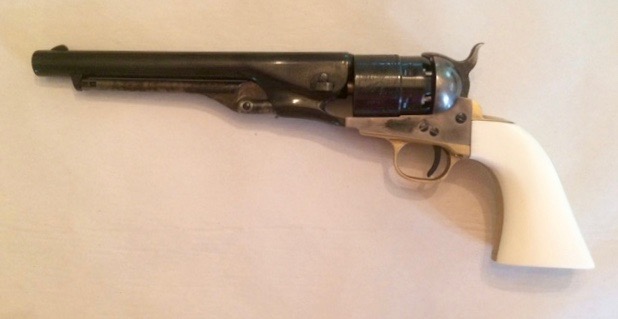
The 1860 Colt .44 Army revolver has been called the best looking revolver ever made. That is debatable, of course, but I tend to agree.  Perhaps more to the point is how well the 1860 Army points.  This may be due to its balance (or, perhaps more accurately, its moment of inertia) and, to me personally, its grip, which is longer than the Colt Single Action Army's and thus fits my hand better.  I own an 1860 Army reproduction by Uberti, and I decided that replacing its walnut grips with synthetic ivory would keep it just as pointable but make it even better looking.

After looking at a number of websites, I ordered a kit from Tombstone Gun Grips of White City, OR. Its website has detailed instructions for making templates from 3x5 index cards; Dave Corbin casts the polyurethane resin grips from these templates.  Although the web site warned that there might be a rather long interval before the order could be filled, my kit--two grips and two spacers--arrived in just a few weeks.

The instructions are quite detailed.  The first step is to make sure that the grips are oversized in all dimensions.  It's relatively easy to reduce them, but not to make them larger.  If they are too small, Dave Corbin will replace them as long as they haven't been altered.

The instructions recommend using contact cement or Gorilla Glue to glue the spacer to first one grip and then the other.  I readily admit to not being the most adept person at gluing objects together, and my previous mistakes have made me prefer glues that are reversible.  That is, if you make a mistake, you can take the pieces apart and start over again.  Contact cement made me uneasy because I almost never have used it.  As for Gorilla Glue, which I have used, I was pretty sure that it was not reversible.  I called the company to  check: once it's set up, I was told, it's permanent.  I  decided therefore to use Brownell's ACRAGLAS epoxy, which can be reversed with a heat gun.

The process begins with flattening the grip frame.  Then you flatten the frame side of each grip.  As the instructions recommend, I used 100 grit paper on a flat surface--in my case, the surface of my drill press table.  The instructions suggest that you paint what you want to flatten with a magic marker.  Assuming you've held the piece vertical, when all the black marks are erased, the surface is flat. Next, work on the corner where the each grip joins the frame: everything follows from this angle being correct. My grips were close, but each one required some judicious sanding and trying before it fit.

While the grips are still a bit oversized, fit the spacer.  Here is where I made the first of my three mistakes.  The instructions state, "Shape the spacer to fit between the hammer spring and the back strap.  It must be as close to a snug fit as you can make it."  Two spacers came with the kit, so I fitted the one with the curve that most closely approximated the inside curve of the back strap and glued it to the right grip panel, clamping them with a C clamp and rubber bands.


See that empty space just above the bottom of the grip frame?  What I failed to realize--and what the instructions don't mention--is that not only the side of the spacer must fit against the back strap (which continues around the butt as well) but the bottom of the spacer must fit snugly as well.  If not, the grip will not keep vertically aligned.

I could have avoided this mistake by looking more closely at the original wooden grip. Fortunately, the solution was simple.  I measured the gap between the bottom of my glued spacer and the frame and cut a piece from the second spacer to fit.  Some sanding and fitting soon made it a snug fit, so I epoxied that extension to the grip as well.


The spacer will now protrude above the frame on the remaining side.  The instructions say to make the spacer flush with the frame but leave the method up to you.  I used a piece of 100 grit sandpaper wrapped around a finger plane (with the blade raised, of course), making sure that the base of the small plane was always over two sides of the grip frame.

This approach worked well for making the spacer flush with the frame, but--my second mistake--I failed to realize that using epoxy to glue the second grip to the spacer would push the grip away from the spacer. Even a thin layer of epoxy has volume, after all, so epoxy between flush surfaces must leave a narrow but discernible gap.  That was the bad news.

The good news was that the epoxy was reversible.  My heat gun mysteriously had gone missing from my shop, so I directed the heat from my wife's hair dryer to the spacer and soon had the bond weakening.  A bit more heat and I could separate the two pieces and scrape off the epoxy.  Making sure to keep the side of the spacer flat, I sanded it until all of it was just a tad below the edges of the back strap.  That gap would accommodate the epoxy and still keep the edges of the grip tight against the grip frame.  Six rubber bands held the grip in place while the epoxy cured.

The left grip slipped just a bit away from the action in the clamping, but I decided I could live with it.  The grips were far from pristine, but I knew that sanding them to be flush with the frame would soon clean them up.

Next came the final fitting and polishing of the grips.  I started with 220 grit paper with the grips off the frame, putting them back on to check my progress.  I soon decided, however, that the quickest way to a flush fit between brass grip straps and poly grips was to depart from the instructions and sand them simultaneously in a shoe-shining fashion.  I took the sandpaper and backed it the long way with duct tape.  I then cut strips into the widths I needed.  As best I could, I was careful to follow the curves of the original grip. The brass of course became scratched, but each successive grit lessened the scratches.  After sanding with 600 grit, I thought I was through.  Two thin coats of wax, and it looked pretty darn good.


And that was how I made my third mistake:  I depended on artificial light to determine I was through.  Given the number of gun stocks I've refinished, I should have known better! The grips were nicely fitted, but looking at them in natural, raking light showed up a number of scratches I had simply not noticed in artificial light.  I marked and sanded each one, and then went through the grades of sandpaper all over again, finishing up this time with 1000 and then 1500 grit--all in natural light.  This time, the grips passed scrutiny.

Two thin coats of Renaissance wax made them look even better.  Here's the result: