Hits and Misses

Hits and Misses

Monday, June 6, 2016

My Family's Puritan Ministers, Part 3 of 3

This is the third of three posts about my recent discovery that my father's side of the family abounded not only in Puritans but in Puritan ministers.  The first post focuses on why Puritan ministers left England for what they hoped would be a "New" England.  The second post concerns those who came in the early 1600's to Masachusetts Bay Colony. 

Other Puritan ministers in my father's family went first to Massachusetts Bay and then on to what is now Connecticut.  Reverend Nicholas Street (1603-1674) was from Bridgewater, Somerset.  Atypically, he earned a bachelor’s degree from Pembroke College, Oxford, before changing to Emmanuel College at Cambridge, where he received his A.M. in 1636.  After coming over on the Susan & Ellen in 1635, he was ordained in Taunton in 1640/1.  Nearly twenty years later, in 1659, he removed to New Haven, the most strict of all the colonies.  So far, I haven't discovered why he moved.

Ephraim Hewitt (1604-1644) was from Wraxall, Warwickshire.  He attended St. John’s, Cambridge, and then became a curate at Knowle, Warwickshire.  He was silenced by John Thornborough, Bishop of Worcester, in 1638; Laud reported that Hewett had “condemned the decent ceremonies commanded by the Church.”  Hewitt consequently arrived in Windsor, CT, the following year.  He was ordained in Windsor in December 1639.  He died five years later.

Reverend John Jones (1593-1665) followed the more typical route of coming to Massachusetts Bay first and later moving to Connecticut.  Born in Northamptonshire, he went to Queens’ College, Cambridge, receiving his A.M. in 1616.  He had become a deacon at Peterborough in 1613; he became rector at Abbot’s Ripton, Huntingdonshire, in 1619.  He served there until 1630, when he was deprived of his living "for refusing to adhere to rites and ceremonies in the book of public prayers."  I don’t yet know how he survived the years between 1630 and 1635, when he sailed on the Defence, together with Peter Shepard.  He lived in Concord from 1635 until 1644, becoming ordained in Cambridge in April 1637, with Peter Buckeley as teacher.  (His daughter Sarah married Bulkeley's son Thomas about 1640.)  In 1644, he moved to Fairfield to become the minister there for the next twenty-one years.  He presumably was present when Goody Knapp was hanged as a witch in 1653.  He died between January 17th and February 9th, 1665.

The most influential of these ministers in my family who came to Connecticut was Thomas Hooker (1586-1647).  As did so many Puritans, he attended Emmanuel College, Cambridge, earning an A.B. in 1608 and an A.M. in 1611.  He then became a Fellow there.  After serving first as a rector in Surrey and then as a lecturer at St. Mary, Chelmsford, in Essex in 1625-29, he was silenced for non-conformity.  Hooker then kept a private school at Little Baddow, Essex, for two years (his usher in the school was John Eliot, later to become famous for his work with the Indians).  Becoming persecuted again, Hooker left for Holland.  He preached at Delfthaven for two years and then hoped to accept a position in the English congregation at Rotterdam.  But because he became involved in a dispute with John Paget, he didn’t obtain that position.

In 1633, Hooker came over with John Cotton on the Griffon.  He became the minister at Newtown (Cambridge), where some 58 from his congregation in Essex, England, had already settled; 53 more were soon to follow, according to Bailyn.  Believing the Boston-Newtown-Watertown area was too crowded, Hooker applied to the General Court for permission to leave and settle in Connecticut.  Fearing that geographic dispersal would weaken the spiritual support afforded by these nearby congregations, the Court denied his petition.  

Undaunted, and never less than contentious, Hooker reapplied the next year, and this time he was successful.  In 1636, he led most of his congregation overland to the Connecticut River, where they founded Hartford.  Although Benjamin Trumbull declares in his romanticized Complete History of Connecticut (1818) that they had to travel “more than a hundred miles, through a hideous and trackless wilderness” with no guide but a compass, they actually could follow an existing Indian trail.  Even if they had more provisions on their way to Hartford than the milk of the 160 cattle Trumbull says they subsisted on, theirs was quite a journey.  Hooker’s wife, my 9th great-grandmother Susanna Garbrand, was so sick that she had to be carried on a litter the entire way.  (She recovered, however, and outlived him by nearly thirty years, marrying twice in succession during that period).  He was the minister for the Hartford church until he died in 1647.  He had at least twenty works published. His Survey of the Sum of Church Discipline (published in 1648) has been called one of the classic statements justifying congregational policy. Their son Samuel went to Harvard College, became a Fellow there in 1654, and was ordained at Farmington, Connecticut, in 1661.

While in Hartford, Hooker mentored Roger Newton (1620-1683).  Newton had matriculated at King’s College, Cambridge, in 1636 but left before graduating.  He arrived in New England in 1638 and in 1640 studied at Harvard College (which had been founded in 1636) but again left without graduating.  Not only did Newton study theology with Hooker, he wooed and married Hooker's daughter Mary in 1644.  How long Newton continued to study with his father-in-law is unclear.  Thomas Hooker died in 1647, but Newton did not follow him as the minister at Hartford.  In October 1652, Newton was ordained as the first minister of Farmington, being installed the first day the church was formed.  He left after three years, and it doesn’t seem to be known what he did in the interval before he was installed at Milford on August 22, 1660.  Newton remained at Milford until his death on June 7, 1683. 

Scholars disagree on how many Puritan ministers came over to New England.  Estimates range from somewhere in the 90’s up to perhaps 130.  The nine ministers in my family that I’ve written about here therefore make up less than 10% of the total.  But all of them had been tried by adversity and not found wanting.  Even after the Parliamentary forces gained control in England, these ministers remained in New England.  (Susan Hardman Moore has estimated that 25% of the ministers who had emigrated returned to England during the Interregnum.)  After their arrival, they devoted themselves to making the best they could of this "new" England, hoping that its renewal would become the saving revival of the older one.  

Even though I find nothing appealing in their Calvinist theology, the research I've done on these ministers has made me respect their integrity.  Part of Thomas Shepard’s journal has survived.  He dedicated it to his son Thomas, writing on the top of the second leaf Paul's admonition in 1 Thessalonians 5:21:  “Try all things and hold fast that which is good.” Thomas Shepard the younger earned a bachelor’s and a master's at Harvard in 1653.  Like his father before him and his son Thomas (who also became a minister) after him, we can assume he did his best not only to move his congregation to practice what he preached, but to follow that way himself.  I have no sympathy for their Puritan theology, but I do respect their unyielding resolution, generation after generation, to do what they conceived to be good, no matter what trials they had to withstand.
_____________

Selected sources:

Ashely, Maurice.  England in the Seventeenth Century.  Penguin Books, 1965.

Bailyn, Bernard.  The Barbarous Years.  The Peopling of British North America: The Conflict of  Civilizations, 1600-1675.  New York:  Vintage, 2012.

Bremer, Francis J.  Shaping New Englands:  Puritan Clergymen in Seventeenth-Century England and New England.  New York:  Twayne Publishers, 1994.

Delbanco, Andrew.  The Puritan Ordeal.  Cambridge, MA:  Harvard Univ. Press, 1989.

Fischer, David Hackett.  Albion’s Seed:  Four British Folkways in America.  Oxford Univ. Press, 1989.

Gura, Philip F.  A Glimpse of Sion’s Glory:  Puritan Radicalism in New England, 1620-1660.    Middletown, CT:  Wesleyan Univ. Press, 1984.

McGiffert,  Michael, ed..  God’s Plot:  Puritan Spirituality in Thomas Shepard’s Cambridge.  Rev. ed.  Amherst:  Univ. of Mass. Press, 1994.

Mather, Cotton.  Magnalia Christi Americana.  London, 1702.  Bk. III, Ch. xvi.

Moore, Susan Hardman.  Pilgrims:  New World Settlers & the Call of Home.  New Haven:  Yale Univ. Press, 2007.

Seller, W. C., and R. J. Yeatman.  1066 and All That.  New York:  Barnes & Noble, 1931.

Weis, Frederick Lewis.  The Colonial Clergy and the Colonial Churches of New England [1936].  Lancaster, MA, 1961.


My Family's Puritan Ministers, Part 2 of 3

One of my forebears, Reverend Thomas Shepard (1605-1649), left a manuscript describing his encounter with Archbishop Laud (see list of sources at the end of Part 3).  We should perhaps allow for Shepard heightening the drama, but he represents Laud in the interview as enraged:  "He asked how long I had lived in his diocese.  I answered, Three years and upwards.  He asked who maintained me all this while, charging me to deal plainly with him, adding withal that he had been more cheated and equivocated by some of my malignant faction than ever was man by Jesuit, at the speaking of which words he looked as though blood would have gushed out of his face and did shake as if he had been handed with an ague fit, to my apprehension by reason of his extreme malice and secret venom."  Shepard, by all accounts one of the mildest of men, begged to be excused from answering (in fact, he had been supported in Essex by Dr. Edmund Wilson, the brother of my ancestor Reverend John Wilson, whom I’ll mention below).  Laud then began to rail bitterly at Shepard, eventually sentencing him as follows:  “I charge you that you neither preach, read, marry, bury, or exercise any ministerial function in any part of my diocese, for if you do, and I hear of it, I will be upon your back and follow you wherever you go, in any part of the kingdom, and so everlastingly disable you.”

We need to recall that Laud wielded both religious and political power.   Laud’s “charge” to Shepard was legal and all-encompassing, having effect throughout the realm of England.  It quite literally took away Shepard’s means of supporting himself as a minister.  Not only that:  I take Laud’s use of “everlastingly” at the closing of his charge—“and so everlastingly disable you”—to mean that any disobedience of Shepard will mean that he’ll be lost both in this life and in the life to come.  The interview ends with Laud exclaiming, “Get you gone, and now make your complaints to whom you will!”  “So away I went,” Shepard relates, and his next phrase quietly underscores that he serves a greater master:  “and blessed be God that I may go to him.”  

For Thomas Shepard and other ministers of the Puritan persuasion, Archbishop Laud’s burning zeal to enforce uniformity made many of them question whether they should—or could—stay in England.  In The Barbarous Years, Bernard Bailyn magisterially sums up the outcomes of Laud’s campaign:  “It created fear and a sense of desperation, forged a mutually supportive community of previously scattered dissidents, steeled their resistance, propelled many from a ‘loose conformity’ to outright nonconformity, and precipitated a willingness on the part of certain of the Puritan leaders to contemplate flight.”

One of the ministers in my family tree who did take flight was Samuel Whiting (1597-1679).   Originally from Boston, Lincolnshire, Whiting received his A.M. from Emmanuel College, Cambridge, in 1620, and, subsequently, his D.D.  He served as Rector of Skirbeck, Lincolnshire, from 1625 to 1636.  His second marriage was to Elizabeth St John in 1629.  When his case came before Laud’s Court of High Commission, the Earl of Lincoln intervened on his behalf.  Having momentarily escaped Laud’s clutches, as he presumably saw it, Whiting came over to New England in 1636 and served as minister in Lynn for the next 43 years.  Three of his sons followed him into the ministry.

Another forebear was Reverend John Wilson (1591-1667), the brother of the Doctor Edmund Wilson who helped support Thomas Shepard in Essex.  He could have had an illustrious career in the Church of England:  not only had he gone to Eton, but his father was a canon at Windsor and his mother was a niece of Archbishop Edmund Grindal.  At King’s College, Cambridge, however, he became a Puritan.  He received his A.M. in 1613.  From 1616-1618 he was a Fellow of King’s.  A lecturer in Sudbury, Sussex, Wilson was suspended in 1627 and imprisoned for seditious speeches.  He was restored after the Earl of Warwick intervened on his behalf.  When he was investigated again, he resigned and emigrated to Boston in 1630.  His wife, Elizabeth Mansfield, flatly refused to accompany him, so he went back to England the next year and eventually persuaded her to return with him.  After being the teacher in Boston, he became the first minister of the First Church in 1632, with John Cotton following him as teacher.  He volunteered to be a chaplain in the Pequot War in 1637.  He remained in Boston until his death in 1667.  His son, grandson, and great-grandson all became ministers in their turn.

Reverend Peter Bulkeley (1583-1659) was the brother of my ancestor Judith Bulkeley.  Their father Edward came from a landed family in Odell, Bedfordshire; he had been a Fellow at St. John’s, Cambridge, earned a D.D., and then became the Rector of Odell.  Peter Bulkeley followed his father to St. John’s, earning his A.M. in 1608 and then on his father’s death becoming Rector in Odell.  The Lord Keeper Williams was a long-standing friend of the family, so he had overlooked first Edward’s and then Peter’s non-conformity, but when Laud became Archbishop in 1633 that was no longer an option.  Bulkeley was silenced with his case being referred to the High Commission.  With no hope of reinstatement, he sold his estate and came over to New England with his family in 1635.    
Peter Bulkeley settled first in Newtown (Cambridge).  The next year, with twelve others, he purchased land from the Indians and began the town of Concord.  John Jones was the first pastor at Concord, and Bulkeley was the teacher.  Then, in 1637, Bulkeley was installed at pastor.  That Concord never suffered attacks by Indians was generally credited to his good relationships with them.  He served the church in Concord until his death in 1659.  A son, Edward, and a grandson, John, followed him into the ministry. 

This brings us back to Thomas Shepard, whom we left right after his interview with the furious Archbishop Laud.  Silenced and unfrocked, Shepard, his first wife Margaret Toutville, and their son Thomas (who would also become a minister) sailed on the Defence to Massachusetts Bay in 1635, arriving on October 3rd.   Thomas Hooker baptized their son, who was about a year old at that point. 

Hooker was about to lead his congregation to the Connecticut River, so Shepard and his congregation bought their houses and property.  Shepard was ordained at Cambridge on February 1, 1636, and ministered there until he died in 1649, aged 44.  Harvard College was located in Cambridge in part because of Shepard's ministry there, and he served as its unofficial chaplain as well as an overseer.  When the college was nearly insolvent, Shepard proposed a "motion of beneficence" to the Confederation of New England in 1644:  each family was asked to donate annually a quarter-bushel of wheat or its equivalence.  The motion gave Harvard nearly 270 pounds over the next nine years.  Shepard had some fifteen works published during his lifetime and after his death.  Three of his four sons followed him into the ministry.  Described by Edward Johnson as a "poor, weak, pale-complexioned man," Thomas Shepard by all accounts was an extraordinary preacher, a "Pastor Evangelicus," in Cotton Mather's phrase.

My Family's Puritan Ministers, Part 1 of 3


Some fifty years ago I took two graduate courses at Stanford on the New England Puritans.  I disliked their doctrinal hairsplitting, their emphasis on predestination, and, closely related to that, their perpetual anxiety about whether they were sanctified.  Ironically, thanks to ancestry.com, I have discovered recently that nearly all the branches on my father’s family tree stem from Puritans.  And not just Puritans, but Puritan ministers.  Faced with this version of cognitive dissonance, I’ve done a lot of research in early American history.  After much reading, I still don’t agree with their doctrines, but I have come to see these Puritan ministers in a different light.   

The program ancestry.com is a great resource for discovering familial relationships extending back in time.  Not surprisingly, it is best at identifying names and supplying relationships:  parental, marital, siblings, and so on.  Previous users have scanned in additional material on what some of these people did, but not all of it is relevant, any more than all the familial relationships are factual.  I perhaps should admit here that tracing generations back into New England is relatively easy.  There are baptismal records, marriage records, wills, and probate records—all of which are in English and many of which can be accessed through ancestry.com.  Research in New England is thus considerably simpler than trying to find information about forebears who may have been living in this country but who continued to use the language of their country of origin.  It is exciting to trace back members of a family, discovering relations between generations, but what I found even more exciting was trying to discover who these people were, fleshing out their names, so to speak, and trying to understand why they were in a given place at a given time.

As I began to get back eight or nine generations, I began to notice that many of them were living in Connecticut.  I wondered why so many of them were there.  Then, going back another generation, I noticed that many of these same families had been in Massachusetts, or, more accurately, the Massachusetts Bay Colony.  Only at this point did I realize that these ancestors of mine had to be Puritans, and therefore the same as the ones I had so disliked studying when I was getting my PhD at Stanford.  These weren’t the equivalents of English Cavaliers, “Wrong but Wromantic,” to quote 1066 and All That; these forebears were Puritans, the equivalent of English Roundheads, “Right but Repulsive.”

Nevertheless, I was related to them, and I felt I owed it to them as my forebears to learn more about them.  I had read David Hackett Fischer’s Albion’s Seed:  Four British Folkways in America some years ago, never dreaming that the chapter on “East Anglia to Massachusetts:  The Exodus of the English Puritans, 1629-41” had anything to do with my family.  I reread that chapter, impressed all over again by the disparate elements Fischer is able to pull together into a coherent whole, and then began to ask historians I knew at Cornell what I should read.  Bernard Bailyn’s The Barbarous Years, a study of the “Peopling of British North America” from 1600-1775, was recommended by everyone.  It is a breathtakingly good overview, and its extensive documentation provided me with a useful guide to further research. 

As I read Fischer and Bailyn and then the primary and secondary sources they cited, I began to notice some names that were similar to the ones I’d traced through ancestry.com.  Could they be the same people?  I checked their dates of birth and death, and to my surprise, they were the same.  Not only were many of my forebears Puritans, some of those Puritans were ministers, key figures in settling first Massachusetts Bay and, very soon after, Connecticut (which at first was an extension of the Bay Colony).

But why, I wondered, were ministers key figures in the Puritan migration to New England?  From what I was reading, a given minister would decide to emigrate, and many in his congregation then would emigrate with him.  I could imagine that a minister might well inspire his flock to follow him, but what factors in England made the ministers want to leave?  Trying to answer that question gave me even more information about these forebears.  

For the sake of convenience, I have divided a longish essay into three parts, the first dealing with the conditions in England that motivated ministers to emigrate; the second with those in my father's family who emigrated to Massachusetts Bay; and the third with those ministers who settled along the Connecticut River. 

Part 1

It’s alway useful to define terms, so let me begin with the term, “Puritan.”  A Puritan is someone who believed that the Protestant Reformation in the 16th century had stopped too soon:  the Church of England still needed to be “purified” further.  Their ideal church was one similar to that of the early Christians.  Puritans wanted to substitute a congregational structure for the hierarchal one of archbishop, bishops, and priests; they wanted to reduce the number of sacraments from seven to two, baptism and communion.  The Puritans viewed The Book of Common Prayer as merely a collection of empty forms that a parrot could pronounce.  What the Puritans believed important for salvation was neither participating in the liturgy nor partaking of grace through the sacraments.  What was critical was reading the written Word in the Bible and hearing the Word explicated in sermons.  Puritans wholeheartedly agreed with Paul in Romans 10:17, “faith cometh by hearing, and hearing by the word of God.”   

Under Queen Elizabeth, who ruled from 1558-1603, the Church of England more or less successfully kept to what has been termed the via media, a middle way between the traditions and practices of Roman Catholicism and those of Continental Calvinism.  Unlike the recrusants, the English Roman Catholics who were persecuted as traitors both to the Church of England and to Queen Elizabeth, the Puritans who kept their heads down were left pretty much alone.

After James VI of Scotland became King James I of England in 1603, however, the Puritan challenge to the hierarchical nature of ecclesiastical authority became an issue.  The reform-minded faction urged the abolition of bishops because they were not sanctioned in the Bible or the early church.  King James correctly saw this issue of ecclesiastical hierarchy as part and parcel of the notion of order that would later became known as the divine right of kings.  At the Hampton Court Conference in 1604,  James agreed to three of the four requests by the Puritans:   he was willing to countenance abolishing baptism by women, let a “preaching ministry” continue, and reduce the number of livings a cleric could have.  But when one of the Puritan representatives suggested that “prophesyings”—meetings of the clergy to expound doctrine—should be revived and any disagreements resulting from them should be referred not to the bishop but to a group of presbyters, King James blew up.  He smote the table with his fist and declared, “No Bishop, no King!”

Matters became even more strained when King Charles I succeeded his father James in 1625.  King James had appointed William Laud as Royal Chaplain,  Not only did Laud continue in that position, but under Charles he gained more and more influence.  Laud became first the Bishop of London and then in 1633 the Archbishop of Canterbury.  Laud controlled the Church’s Court of High Commission and the Privy Council’s criminal Court of Star Chamber.  To ensure uniformity of worship, Laud began the practice of “visitations” all over the country to verify that worship followed the Thirty-nine Articles and the Book of Common Prayer.  If he saw his efforts as curing the Church of a malignancy, Puritans saw them as persecution of the godly.  

And thus we have come to compelling reasons for ministers of the Puritan persuasion to migrate.  As visitation after visitation occurred, as minister after minister was stripped of his living, excommunicated, or imprisoned, Puritan ministers began to believe that a new age of martyrs was almost at hand, one that would soon replicate the imprisonments, the tortures, and the burnings at the stake in the reign of Queen Mary.  


Friday, May 20, 2016

Not Coming Over on the Mayflower


I’ve been doing some genealogical research on my father’s side of my family.  He knew some names as far back as his great grandfather and several stories, but that was about it.  One family story had some ancestor (name unknown) settling in Long Island in 1642, and another story posited someone equally unknown being a major in the Great Swamp Fight (whenever that was), but that was the extent of it.  As so often happens, neither of those stories appears to be true.  What I have discovered, however, is that some were captured by the Indians, or fought in various wars, or founded towns.  I thought I’d devote a series of posts to some of these individuals, trying to place their lives in their historical context.  This post focuses on my ancestor who refused to come over to America on the Mayflower

His name was Thomas Blossom, and he was born in in 1568 in Parham, Somerset County, England.  Blossom was one of those who fervently believed that the Church of England required further reformation.  He shared with those reform-minded Puritans the conviction that the entire episcopal hierarchy of archbishop, bishops, and priests was a corrupt, papist innovation, sanctioned neither by the Bible nor by the practices of the early Christians.  Instead of this top-down structure, as we might describe it, Blossom wanted a bottom-up, congregational structure.  A few God-fearing worshippers would form their own congregation, elect a minister and perhaps a teacher, and remain altogether independent of every other congregation.  This independence meant in turn that their congregation would be entirely apart—separate from—the Church of England.  As a consequence, in their time they were called Separatists; we have mythologized them as the Pilgrims.

Under the successive reigns of Queen Elizabeth and King James I, the Church of England was the national church.  Attendance at Sunday service was obligatory; you were fined for being absent.  The more radical Puritans like the Separatists had therefore only two choices:  they could meet to worship in secret, or they could leave the country and go to Holland, another Protestant country, and one far more tolerant than England.  Blossom may well have done both, marrying his first wife Ann Sarah Palmer (1570?-1650) about 1588 or so and taking care to avoid notice by the ecclesiastical establishment.  His daughter Frances (1589?-1635) apparently was borne by Ann Palmer.  Blossom’s second marriage took place in 1605:  he married Anne Elsdon, who was the mother of his two sons Thomas and Peter.  In 1609, his daughter Frances married William Palmer (no relation to Blossom’s first wife), by trade a maker of nails. 

At some point, Blossom and his family emigrated to Holland, first probably to Amsterdam, where William Brewster had established a congregational church in 1608, and then, like Brewster in 1609, to Leiden, where they became members of John Robinson's church.  In Leiden, the Separatists were indeed free to worship as they pleased.   The difficulty was that, with a few exceptions, the Separatists were desperately poor.  Not only were most of them at an initial disadvantage in knowing no Dutch, but many of them had been farmers and herdsmen.  In Leiden, an urban center, they could gain only menial employment at minimal wages.  Worried about their children becoming more Dutch than English, anxious that the twelve year truce between Catholic Spain and Protestant Holland would be expiring in 1621 and war might resume, the Separatists began to consider emigrating to North America.

When their congregation finally obtained financial backing from a company of investors in London, Blossom decided that he, his wife, and his two sons would be among the 30 or so passengers on the Speedwell, a ship that would sail from Holland, meet the Mayflower in England, and then sail in company to New England.  The Speedwell had been fitted with new masts and sails, and there is some evidence that its master deliberately overmasted the ship because he had no desire to cross the Atlantic.  The two ships met up at Southampton and duly sailed.  Both began to leak, the Speedwell alarmingly so, with the result that they returned to Dartmouth for repairs.  Again they set out, and again the Speedwell leaked alarmingly.  Back they went to Plymouth, and this time the master refused to continue in the Speedwell.  The outcome was that the already crowded Mayflower took aboard some of the Speedwell’s passengers and made the voyage alone (it may be relevant that the Speedwell continued subsequently as a trading vessel for a number of years).  They arrived late in the year, and what with inadequate shelter, insufficient food, diseases, and the cold, nearly half of the passengers died that winter.

Thomas Blossom and his family were among those who decided not to go on the Mayflower.  They returned to Leiden, presumably hoping that they could soon make the crossing to New England.   Money continued to be scarce, so not many more were able to emigrate.  His son-in-law William Palmer came over on the Fortune in 1621; his daughter Frances, on the Anne in 1623.  Not until 1629, nine years after the Mayflower sailed from Old Plymouth, did Blossom and his family finally reach New Plymouth—on, coincidentally, a ship also named the Mayflower, but an altogether different vessel.  

Thomas Blossom was soon elected a deacon of the church in Plymouth.  (Robinson's church in Leiden appointed deacons for life, so Blossom may well have been a deacon before coming to Plymouth, but there's no record of it.)  Apparently he fulfilled that lay office well for the three years he had yet to live.  He died in 1632.  In his history Of Plymouth Plantation, William Bradford mentions Blossom by name as one of the "ancient friends" from Holland dead from an "infectious fever" that struck upwards of twenty people.  In The Barbarous Years (New York, 2012), the first volume of his work on “The Peopling of British North America,” Bernard Bailyn quotes a contemporary description of Deacon Thomas Blossom:  he was “a holy man and experienced saint, . . . competently accomplished with abilities” (349).  That sounds to me like a worthy epitaph.


Wednesday, April 6, 2016

Unnatural Sex and the Puritans

I've been doing some research on my father's side of the family, and I've discovered that nearly all of them came not from New York, as I'd assumed, but from Massachusetts and Connecticut.  Most of them had left England by the mid-1600's, so I've been reading up on the Puritans and Pilgrims. One of the things I've found out is that they were appalled by unnatural sex.  By that phrase they meant everything except intercourse between a husband and wife.  Masturbation was condemned everywhere in New England and made a capital crime in the colony of New Haven.  Following the Bible, adultery and sodomy were capital crimes.

And so was bestiality, sex with animals and fowls.  In Albion's Seed:  Four British Folkways in America (Oxford Univ. Press, 1989), David Hackett Fisher relates the case of George Spencer, a servant with only one eye in New Haven.  Spencer had been anything but a model servant, and when a sow gave birth to a piglet with only one eye, Spencer was accused of bestiality.  Under great pressure, Fisher relates, Spencer confessed, then recanted, confessed a second time, and then recanted again.

Two witnesses were required to convict him of bestiality, but the magistrates, determined to find him guilty, got around that inconvenient technicality.  The one-eyed piglet was admitted as one witness, and Spencer's confession was admitted as the other one, even though he'd recanted it.  Although Fischer is silent on this point, New England courts treating cases of bestiality followed the Biblical injunction of Leviticus: "And if a man lie with a beast, he shall surely be put to death: and ye shall slay the beast" (20:15), So both George Spencer and the sow would have been executed.

Fortunately for John Lawrence at his trial in 1677, the Court of Assistants in Cambridge was not willing to circumvent the required two witnesses for bestiality.  In Sex in Middlesex:  Popular Mores in a Massachusetts County, 1649-1699, (Univ. of Mass. Press, 1986), Roger Thompson relates that John Lawrence was seen by Thomas Michelson between seven and eight in the morning "standing on a tree that lay along on the ground having his face towards his mares tail and his hand clasped about her Buttock."  After awhile, he deposed, Lawrence "turned the mares tayle on one side and then he again clasped his hands about her Buttocks as before and wrought with his body against hers."  But a second person near the scene, one Isaac Amsden, deposed that he was too far away to witness the act, so the case was dismissed.

Another notable case was that of Thomas Granger, a sixteen or seventeen year-old servant in Duxbury, one of the Pilgrim settlements in Massachusetts. William Bradford found it horrible to mention his case in his history, Of Plymouth Plantation, but he believed that the truth of history required it.  Granger was first seen copulating with a mare ("I forbear particulars," Bradford comments primly), and when he was examined on that topic, he confessed to buggery not only with the mare "at sundry times" but with "a cow, two goats, five sheep, two calves, and a turkey" (Bk. II, Chapter 32).

Although Granger at first denied this charge, he eventually confessed to the entire court and was condemned to death.  But there was some difficulty in following Leviticus.  One sheep looked much like another, with the result Granger had to identify each one he'd had sex with: "whereas some of the sheep could not so well be known by his description of them, others with them were brought before him and he declared which were they and which were not."  On 8 September 1642, the executions took place: "first the mare and then the cow and the rest of the lesser cattle were killed before his face," and then Granger himself was executed.

Remarkable as these cases are, they seem far from typical.  Roger Thompson points out in Sex in Middlesex that only two men were executed for bestiality in Massachusetts in the seventeenth century. (The one-eyed George Spencer lived in Connecticut.)  Thompson's meticulous study of town and court records led him to believe that most people in that county were as law abiding about sexuality as they were about other matters.  Not all inhabitants were members of the church, and not all church members were godly, but bestiality was not common.  In part, the occurrences we know about may have been the few ones in which the act was observed (as it was not in the case of George Spencer), and more perhaps may have taken place in private.  But many members of these communities believed that God was watching them--"God can see you in the dark" was a common warning--and might well punish all of them for the sins of the few.  So were they taught, and so they believed--at least for the greater part of the seventeenth century.  They were called to be communities of their brothers' keepers for the greater glory of God, and in that watchful context what they termed "abominations in the eyes of the Lord" accordingly would have been rare.

Thursday, March 10, 2016

Why the Puritan John Winthrop Gave Up Hunting


JohnWinthropColorPortrait.jpg

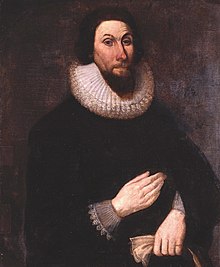
John Winthrop (1587/88-1649), who was to become the first Governor of the Massachusetts Bay Company in 1629, belonged to the socio-economic class in England that could count hunting among its privileges.  Nevertheless, he gave it up.  In 1611, when he was  twenty-three,  Winthrop carefully enumerated his reasons:

"Finding by much examination that ordinary shooting in a gun, etc:  could not stand with a good conscience with myself, as first, for that it is simply prohibited by the law of the land, upon this ground amongst others, that it spoils more of the creatures than it gets:  2 it procures offence unto many:  3 it wastes great store of time:  4 it toils a man's body overmuch:  5 it endangers a man's life, etc.:  6 it brings no profit all things considered:  7 it hazards more of a man's estate by the penalty of it, than a man would willingly part with:  8 it brings a man of worth and godliness into some contempt:  --lastly for mine own part I have been crossed in using it, for when I have gone about it not without some wounds of conscience, and have taken much pains and hazarded my health, I have gotten very little but most commonly nothing at all towards my cost and labour."

Many today would probably agree with reasons 1-8, but to my ear the final reason is the most telling. It's the only reason that is personal rather than impersonal.  Here, and here alone, I'd suggest, for just a moment we can hear the human voice of John Winthrop, a hunter who has returned home too many times empty-handed.  Despite enduring "some wounds of conscience," despite undergoing many pains and exhausting himself, he typically was unsuccessful.  That lack of success--his being crossed, thwarted in his pursuit of game, and almost certainly missing what he shot at--appears to be what motivated his inventory.  Reasons 1-8, then, serve less as reasons to change his behavior than as rationalizations.

What's fascinating to me is that even after enumerating no less than eight of these arguments, his own frustration explodes at the end, overriding everything he has listed before.  By the time he had his portrait painted, however, his projected self, his public persona, if you will, is much more contained.   He appears to be completely in control.  When a portrait was commissioned in that period, hands were an added expense. Winthrop is quietly showing that he could afford to have both hands painted, and his affluence is further displayed by the lace that edges both his ruff and his cuffs.  This is not a portrait composed to engage its audience.  His hands are not making a gesture outwards:  the upper hand, indeed, is turned inward, held close to his chest.  His youthful frustrations are long gone--and to that degree, he appears less human and much more the austere representative of Puritan authority.

JohnWinthropColorPortrait.jpg

Source:  The Winthrop Papers, 1498-1649, 5 vols. (Boston, 1929-1947), vol. I, p. 165; quoted by Patrick M. Malone, The Skulking Way of War:  Technology and Tactics Among the New England Indians (Lanham, MD:  Madison Books, 1991), p. 54.

Monday, February 15, 2016

Reshaping the Stock on a Marlin Golden 39 A

A few years ago, I purchased a used Marlin 39 A .22 with the idea that it would provide an understudy to my Marlin lever actions in .45-70 and (my favorite) .38-55.  Carbines have their good points, but these two lever guns were rifles, so I wanted the relatively long 24" barrel of the 39 A.  (If you want a carbine, look for the Marlin 39 M, the Mountie model, and be prepared to pay more for it.)

I didn't think to take a photo of my rifle when I acquired it, but (except for the scope) it looked almost exactly like the one illustrated here in an earlier Marlin advertisement:


Following the Marlin 39, introduced in 1921, the 39 A was introduced in 1939.  My Golden model with its gold trigger was manufactured in 1971 (and thus is now a so-called early model, the newer model dating from 1983).  Typically for its time, it had a butt stock and fore end that to my eye called out for reshaping.  The fore end was an exaggerated beavertail; the butt stock had an exaggeratedly long pistol grip.  The curve from the wrist to the nose was slack, and the fluting at the nose of the comb was clunky. Both fore end and butt bulged outwards from the slim receiver, giving the rifle an oddly wasp-waisted look when viewed from above or below.  A minor point was that I didn't like the Marlin icon of a bull's-eye in white and black plastic near the butt's sling swivel.  It could be argued the bull's eye complements the white spacers at the grip cap and buttplate, but they were going to go.  So, too, was the bull's eye.  In addition, I needed a longer length of pull.

The fore end was a reasonably quick fix.  The earlier Marlin 39's had considerably slimmer fore ends, so I removed the fore end and simply planed down its width and depth until they corresponded to the dimensions of the receiver and the fore end cap.  

As for the butt, getting rid of the white spacer and then adding a red rubber recoil pad gave me the length of pull I wanted.  A pad of course is not needed to reduce recoil on a .22 rimfire, but the friction from the rubber pad can keep the rifle from falling down when it's stood upright on a smooth surface.

Slimming down the butt stock was more of a challenge.  I reduced the width of the comb until my eye was looking down the barrel when the rifle came up to my right shoulder (I also followed the same procedure for my left shoulder).  I then tapered the sides of the comb to eliminate the fluting at the nose.  Filling the cavity where the bull's eye had been with a matching piece of wood was straightforward.  I cut back and slimmed down the pistol grip until its diameter felt comfortable and substituted for the rounded black plastic grip cap a flat piece of ebony, attaching it with black epoxy.  Rubber bands made clamping easy:


Sanding and whiskering  were straightforward.  Next came dying the stock to give it more color.  I used a blend of aniline dyes (3 parts Dark Walnut, 1 part Red Mahogany, and 1/2 part Antique Cherry) because they don't have pigment to obscure the grain.  I then added a coat of home-made walnut brew.  Here's the result:


The last steps were adding a coat of alkanet oil.  I let that dry for three days, then steel-wooled the stock to make sure no oil remained on the surface.  After burning off the tiny particles of steel wool, I started applying very thin coats of Tru-Oil, sanding them in until the pores were filled, and rubbing down the last coat of Tru-Oil with auto rubbing compound.

Checkering came next.  The black walnut was rather coarse, so I used 18 LPI, adding a narrow border.  The checkering wraps around the fore end.  The checkering pattern for pistol grip came from the illustrations of the Marlin Fire Arms catalog from June 1897 (available very reasonably from Cornell Publications) and from William S. Brophy's photographs in Marlin Firearms: A History (Stackpole, 1989).  Here is a shot of the checkering in the white, rather a contrast to the butt with its richer colors from the dye, alkanet oil, and coats of Tru-oil:


After completing the checkering, I carefully scraped inadvertent over-runs and then sanded the divots smooth with 400 grit paper.  I dyed the panels as before with my aniline blend and my walnut brew, rubbed in a coat of alkanet oil, and then brushed on a finishing coat of satin spar varnish diluted 50-50 with mineral spirits.  Touching up with Tru-Oil completed the job.

My friend Mike Bennett drilled and tapped its tang for a Marble's tang sight.  This is a tricky job, because it's illegal to deface any part of the serial number on the tang.  He used a shotgun bead drill fixture and a tap guide from Brownell's to line everything up and keep the drill and tap straight.

This is a shot of the receiver, checkered grip, and tang sight:

This 39 A is now considerably trimmer.  Here, again, is where I started:


And here's the outcome:  a sleeker stock with a shortened pistol grip, a slimmer fore end, and checkering.  The Marble's tang sight now complements its resemblance to earlier Marlin 39's.


Word has it that the quality Marlin Firearms has long been known for is becoming a thing of the past. If you've ever thought of owning a 39 A, now might be the time to buy a used one.  Older ones are still reasonably priced, but they're getting more expensive.  If current build quality continues to deteriorate, prices for the older model could jump dramatically.