Gail Collins has a good comment in her January 11, 2017, Op-Ed piece in the New York Times, "Trump, Sex and Lots of Whining."
Referring to his press conference the day before, Collins notes wryly that President Elect Trump declared that "he'll release his taxes once the audit is finished. (You remember that audit. Its friends call it Godot.)"
Jan. 23, 2017, Postscript: Today's NY Times reports that Kellyanne Conway declared on ABC's "This Week" yesterday that Trump "is not going to release his tax returns."
That puts our new president in the dubious position of being the first president since the early 1970's to decline to release information on his taxes.
Why is this important? Two reasons. Only by releasing his taxes can we assess how much he owes to whom. Only through examining his returns can we see whether he's separated himself enough from his businesses and therefore will not be subject to conflicts of interest. Nothing about the audit would have prevented him releasing this information earlier; nothing prevents him releasing it now.
So three questions emerge. First, what is President Trump determined to hide?
Second, What alternative universe is he living in that he thinks he can get away with this?
Third, Just how stupid does he think we are?
Hits and Misses

Thursday, January 12, 2017

Saturday, December 24, 2016
Duly Noted: Deplorables, or Disposables?
“Duly Noted” are posts that call attention to work by other people. “Deplorables, or Disposables?” summarizes my friend Arthur J. Kover’s research on the degree to which Americans feel that they are disposable. Arthur Kover adapted his work for publication in a magazine, but apparently no editors appreciated its relevance. His work deserves a wider recognition because it presciently identifies an attitude that led to Donald Trump’s election.
In 2013, Arthur Kover and Howard Moskowitz did a study of 250 people drawn randomly from a larger, representative panel. The 250 people were asked to evaluate the chances of six hypothetical persons being laid off. These hypothetical individuals were from varying occupations: a hotel maid from Jamaica; the owner of a local deli; a machinist in a US company; a teacher in an urban high school; a stockbroker; and an executive in a large international company. A subsequent study included two more hypothetical people, a fashion model and “a person like me.”
A constant was calculated to give an overall idea of the probability of anyone being disposed of. This single number is the contingent probability of anyone thinking anyone else could be disposed of. For this study, the constant was 27. This number represents the estimate that between one-quarter and one-third of the populace would think that others—any others—could be thrown away.
27 may not appear to be a large proportion, but there are some surprising aspects here. One is that there is relatively little difference from this base contingent probability for any of the six hypothetical people. That means that people believe that nearly everyone in our society has an equal chance of being disposed of. Everyone is vulnerable.
The case was different in regard to the two added hypothetical people. As one might readily expect, most respondents viewed the fashion model as having a greater chance of being disposed of. In contrast, “the person like me” was viewed as having a lower chance of being thrown away. Objectively, perhaps, a respondent might acknowledge that this could indeed happen, but subjectively it would be more likely to happen to somebody else. (The research data is noted at the end of this post.)
Early in 2015, Arthur Kover did a second study that was qualitative rather than quantitative. He wanted to explore how people felt about their perceived vulnerability. He interviewed six men and two women, ranging in age from mid-twenties to almost ninety. Their occupations included a retired police chief from a small town, a college student, a truck driver, a retired professor of sociology, a building contractor, a homemaker, a high school teacher with tenure, and an unemployed laborer. The retired police chief rejected the idea that people could be thrown away: “When bad things happen, you just dust yourself off and find something else. It’s a question of character.” The high school teacher saw disposability coming down the line in the not so distant future: “Just wait and see—tenure won’t mean anything in five or ten years.”
The other six all viewed themselves at risk of being disposed of. Socio-economic level mattered less than the drastic external changes time could bring about: no one was secure; everyone was living on the edge.
What both of these studies revealed is that nearly all feel their livelihoods at risk. But Kover points out that the disposability of people is not restricted to employment, even though that is a large part of it. Nor is it about a kind of passivity, a refusal to take charge of your own life and find something else—a defect of character, as that retired police chief described it. Rather, the disposability of people involves the specter of being abandoned. People don’t return your calls. Friends melt away. Family life deteriorates. The world becomes indifferent to you, and then you internalize that difference.
In this situation, Kover suggests, individuals will not band together to become a larger force. Every abandoned person carries the past within his or her being. The former executive and the former machinist had little or no contact in their past lives. Their pasts prevent them from seeing their common plight, The more the stressful present impinges on them, the more they will retreat into the past to erect new walls.
Kover concluded this portion of his study by asking an acute rhetorical question, one the more striking because he formulated it well before the Republican primaries. He asks, “Does America need a demagogue to effect even some change? Who will be the next Savonarola, willing to take on that risk? and what group, faith based or political, corporate conglomerate or some idealized 1776 revolutionists—will he or she represent?”
Now we know the answer to that question, even though many of us are dreading what those changes may involve. In these terms, “Make American Great Again” was the perfect slogan. The voters who gave Trump his Electoral College (if not popular) majority are more accurately characterized not as deplorables but as disposables. Their only hope lay in a demogogue, and Trump told them what they wanted desperately to hear. Arthur Kover nailed it.
—————-
For supporting data, see Howard Moskowitz et al., Directory 40 (Mind Genomics Books), vol 12 (Fraying of America): https://www.dropbox.com/sh/su4cyn94o0w5x21/AAB-ITyP_sqwmFXH1hB_WksJa/40.MG.Books.New.Novum.Organum?dl=0&preview=New.Novum.12.Fraying.Nov.2014.pdf.
The qualitative research is copyrighted by Arther J. Kover and reprinted with permission.
The qualitative research is copyrighted by Arther J. Kover and reprinted with permission.
Tuesday, November 1, 2016
Duly Noted: Do Roe Deer Know North and South?
"Duly Noted" posts pass on information gathered from other sources. This post was sparked by my reading Jason G. Goldman's summary of some research on the escape patterns of European roe deer that appeared in the October 2016 Scientific American. I found his summary so interesting that I looked up and read the original article.
This research was funded by a grant from the Czech Republic and published as "Compass-controlled escape behavior in roe deer" by Petr Obleser, Vlastimil Hart, E. Pascal Malkemper, et al., in Behavioral Ecology and Sociobiology, 20: 1345 (August 2016). Roe deer graze in open fields and run away when they see humans, so these researchers deliberately spooked 188 groups of deer grazing in three different areas during April and August of 2014. 68 were males, 120 were females. 115 were singles; 45 were pairs; 19 were groups of three; 5 were groups of four; and 4 were groups of five. Rather than running directly away from the humans or toward the nearest cover, the roe deer preferred heading toward magnetic north or south.
This magnetic alignment was more pronounced in groups than in singles. When an observer approached from the east or the west, the deer did not flee in the opposite direction, but northward or southward. There are advantages in a herd fleeing in the same direction: individuals can escape without colliding with each other, and they can reassemble easily as a group once the perceived threat is over. But that would be true for any direction the herd took--the question is, why did these deer so consistently escape to either the north or the south? These researchers conclude that the deer might be able to detect the earth's magnetic field.
All kinds of questions immediately come to mind. Is this behavior consistent in other seasons of the year? In areas other than South Bohemia and West Moravia? And if so, to what degree, if any, does it hold for other species of deer?
I confess I've never paid attention to the escape directions of the mule deer or whitetails that I've hunted, but I'm going to start. If anyone else does the same and passes on the information, I'll be happy to post the results. You can reach me at ghcox3@gmail.com.
This research was funded by a grant from the Czech Republic and published as "Compass-controlled escape behavior in roe deer" by Petr Obleser, Vlastimil Hart, E. Pascal Malkemper, et al., in Behavioral Ecology and Sociobiology, 20: 1345 (August 2016). Roe deer graze in open fields and run away when they see humans, so these researchers deliberately spooked 188 groups of deer grazing in three different areas during April and August of 2014. 68 were males, 120 were females. 115 were singles; 45 were pairs; 19 were groups of three; 5 were groups of four; and 4 were groups of five. Rather than running directly away from the humans or toward the nearest cover, the roe deer preferred heading toward magnetic north or south.
This magnetic alignment was more pronounced in groups than in singles. When an observer approached from the east or the west, the deer did not flee in the opposite direction, but northward or southward. There are advantages in a herd fleeing in the same direction: individuals can escape without colliding with each other, and they can reassemble easily as a group once the perceived threat is over. But that would be true for any direction the herd took--the question is, why did these deer so consistently escape to either the north or the south? These researchers conclude that the deer might be able to detect the earth's magnetic field.
All kinds of questions immediately come to mind. Is this behavior consistent in other seasons of the year? In areas other than South Bohemia and West Moravia? And if so, to what degree, if any, does it hold for other species of deer?
I confess I've never paid attention to the escape directions of the mule deer or whitetails that I've hunted, but I'm going to start. If anyone else does the same and passes on the information, I'll be happy to post the results. You can reach me at ghcox3@gmail.com.
Monday, September 26, 2016
Fitting New Grips to a Uberti 44 Army & Fixing Three Mistakes
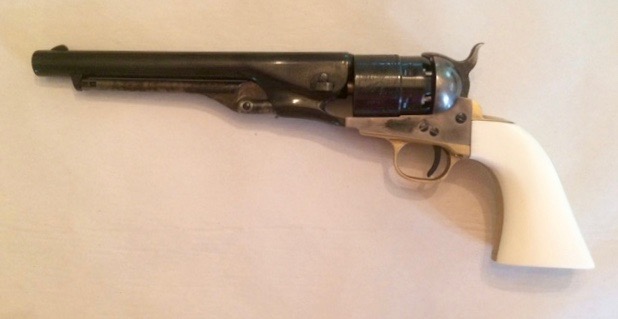
The 1860 Colt .44 Army revolver has been called the best looking revolver ever made. That is debatable, of course, but I tend to agree. Perhaps more to the point is how well the 1860 Army points. This may be due to its balance (or, perhaps more accurately, its moment of inertia) and, to me personally, its grip, which is longer than the Colt Single Action Army's and thus fits my hand better. I own an 1860 Army reproduction by Uberti, and I decided that replacing its walnut grips with synthetic ivory would keep it just as pointable but make it even better looking.
After looking at a number of websites, I ordered a kit from Tombstone Gun Grips of White City, OR. Its website has detailed instructions for making templates from 3x5 index cards; Dave Corbin casts the polyurethane resin grips from these templates. Although the web site warned that there might be a rather long interval before the order could be filled, my kit--two grips and two spacers--arrived in just a few weeks.
The instructions are quite detailed. The first step is to make sure that the grips are oversized in all dimensions. It's relatively easy to reduce them, but not to make them larger. If they are too small, Dave Corbin will replace them as long as they haven't been altered.
The instructions recommend using contact cement or Gorilla Glue to glue the spacer to first one grip and then the other. I readily admit to not being the most adept person at gluing objects together, and my previous mistakes have made me prefer glues that are reversible. That is, if you make a mistake, you can take the pieces apart and start over again. Contact cement made me uneasy because I almost never have used it. As for Gorilla Glue, which I have used, I was pretty sure that it was not reversible. I called the company to check: once it's set up, I was told, it's permanent. I decided therefore to use Brownell's ACRAGLAS epoxy, which can be reversed with a heat gun.
The process begins with flattening the grip frame. Then you flatten the frame side of each grip. As the instructions recommend, I used 100 grit paper on a flat surface--in my case, the surface of my drill press table. The instructions suggest that you paint what you want to flatten with a magic marker. Assuming you've held the piece vertical, when all the black marks are erased, the surface is flat. Next, work on the corner where the each grip joins the frame: everything follows from this angle being correct. My grips were close, but each one required some judicious sanding and trying before it fit.
While the grips are still a bit oversized, fit the spacer. Here is where I made the first of my three mistakes. The instructions state, "Shape the spacer to fit between the hammer spring and the back strap. It must be as close to a snug fit as you can make it." Two spacers came with the kit, so I fitted the one with the curve that most closely approximated the inside curve of the back strap and glued it to the right grip panel, clamping them with a C clamp and rubber bands.

See that empty space just above the bottom of the grip frame? What I failed to realize--and what the instructions don't mention--is that not only the side of the spacer must fit against the back strap (which continues around the butt as well) but the bottom of the spacer must fit snugly as well. If not, the grip will not keep vertically aligned.
I could have avoided this mistake by looking more closely at the original wooden grip. Fortunately, the solution was simple. I measured the gap between the bottom of my glued spacer and the frame and cut a piece from the second spacer to fit. Some sanding and fitting soon made it a snug fit, so I epoxied that extension to the grip as well.

The spacer will now protrude above the frame on the remaining side. The instructions say to make the spacer flush with the frame but leave the method up to you. I used a piece of 100 grit sandpaper wrapped around a finger plane (with the blade raised, of course), making sure that the base of the small plane was always over two sides of the grip frame.
This approach worked well for making the spacer flush with the frame, but--my second mistake--I failed to realize that using epoxy to glue the second grip to the spacer would push the grip away from the spacer. Even a thin layer of epoxy has volume, after all, so epoxy between flush surfaces must leave a narrow but discernible gap. That was the bad news.
The good news was that the epoxy was reversible. My heat gun mysteriously had gone missing from my shop, so I directed the heat from my wife's hair dryer to the spacer and soon had the bond weakening. A bit more heat and I could separate the two pieces and scrape off the epoxy. Making sure to keep the side of the spacer flat, I sanded it until all of it was just a tad below the edges of the back strap. That gap would accommodate the epoxy and still keep the edges of the grip tight against the grip frame. Six rubber bands held the grip in place while the epoxy cured.
 The left grip slipped just a bit away from the action in the clamping, but I decided I could live with it. The grips were far from pristine, but I knew that sanding them to be flush with the frame would soon clean them up.
Next came the final fitting and polishing of the grips. I started with 220 grit paper with the grips off the frame, putting them back on to check my progress. I soon decided, however, that the quickest way to a flush fit between brass grip straps and poly grips was to depart from the instructions and sand them simultaneously in a shoe-shining fashion. I took the sandpaper and backed it the long way with duct tape. I then cut strips into the widths I needed. As best I could, I was careful to follow the curves of the original grip. The brass of course became scratched, but each successive grit lessened the scratches. After sanding with 600 grit, I thought I was through. Two thin coats of wax, and it looked pretty darn good.

And that was how I made my third mistake: I depended on artificial light to determine I was through. Given the number of gun stocks I've refinished, I should have known better! The grips were nicely fitted, but looking at them in natural, raking light showed up a number of scratches I had simply not noticed in artificial light. I marked and sanded each one, and then went through the grades of sandpaper all over again, finishing up this time with 1000 and then 1500 grit--all in natural light. This time, the grips passed scrutiny.
Two thin coats of Renaissance wax made them look even better. Here's the result:

After looking at a number of websites, I ordered a kit from Tombstone Gun Grips of White City, OR. Its website has detailed instructions for making templates from 3x5 index cards; Dave Corbin casts the polyurethane resin grips from these templates. Although the web site warned that there might be a rather long interval before the order could be filled, my kit--two grips and two spacers--arrived in just a few weeks.
The instructions are quite detailed. The first step is to make sure that the grips are oversized in all dimensions. It's relatively easy to reduce them, but not to make them larger. If they are too small, Dave Corbin will replace them as long as they haven't been altered.
The instructions recommend using contact cement or Gorilla Glue to glue the spacer to first one grip and then the other. I readily admit to not being the most adept person at gluing objects together, and my previous mistakes have made me prefer glues that are reversible. That is, if you make a mistake, you can take the pieces apart and start over again. Contact cement made me uneasy because I almost never have used it. As for Gorilla Glue, which I have used, I was pretty sure that it was not reversible. I called the company to check: once it's set up, I was told, it's permanent. I decided therefore to use Brownell's ACRAGLAS epoxy, which can be reversed with a heat gun.
The process begins with flattening the grip frame. Then you flatten the frame side of each grip. As the instructions recommend, I used 100 grit paper on a flat surface--in my case, the surface of my drill press table. The instructions suggest that you paint what you want to flatten with a magic marker. Assuming you've held the piece vertical, when all the black marks are erased, the surface is flat. Next, work on the corner where the each grip joins the frame: everything follows from this angle being correct. My grips were close, but each one required some judicious sanding and trying before it fit.
While the grips are still a bit oversized, fit the spacer. Here is where I made the first of my three mistakes. The instructions state, "Shape the spacer to fit between the hammer spring and the back strap. It must be as close to a snug fit as you can make it." Two spacers came with the kit, so I fitted the one with the curve that most closely approximated the inside curve of the back strap and glued it to the right grip panel, clamping them with a C clamp and rubber bands.

I could have avoided this mistake by looking more closely at the original wooden grip. Fortunately, the solution was simple. I measured the gap between the bottom of my glued spacer and the frame and cut a piece from the second spacer to fit. Some sanding and fitting soon made it a snug fit, so I epoxied that extension to the grip as well.

The spacer will now protrude above the frame on the remaining side. The instructions say to make the spacer flush with the frame but leave the method up to you. I used a piece of 100 grit sandpaper wrapped around a finger plane (with the blade raised, of course), making sure that the base of the small plane was always over two sides of the grip frame.
This approach worked well for making the spacer flush with the frame, but--my second mistake--I failed to realize that using epoxy to glue the second grip to the spacer would push the grip away from the spacer. Even a thin layer of epoxy has volume, after all, so epoxy between flush surfaces must leave a narrow but discernible gap. That was the bad news.
The good news was that the epoxy was reversible. My heat gun mysteriously had gone missing from my shop, so I directed the heat from my wife's hair dryer to the spacer and soon had the bond weakening. A bit more heat and I could separate the two pieces and scrape off the epoxy. Making sure to keep the side of the spacer flat, I sanded it until all of it was just a tad below the edges of the back strap. That gap would accommodate the epoxy and still keep the edges of the grip tight against the grip frame. Six rubber bands held the grip in place while the epoxy cured.

Next came the final fitting and polishing of the grips. I started with 220 grit paper with the grips off the frame, putting them back on to check my progress. I soon decided, however, that the quickest way to a flush fit between brass grip straps and poly grips was to depart from the instructions and sand them simultaneously in a shoe-shining fashion. I took the sandpaper and backed it the long way with duct tape. I then cut strips into the widths I needed. As best I could, I was careful to follow the curves of the original grip. The brass of course became scratched, but each successive grit lessened the scratches. After sanding with 600 grit, I thought I was through. Two thin coats of wax, and it looked pretty darn good.

And that was how I made my third mistake: I depended on artificial light to determine I was through. Given the number of gun stocks I've refinished, I should have known better! The grips were nicely fitted, but looking at them in natural, raking light showed up a number of scratches I had simply not noticed in artificial light. I marked and sanded each one, and then went through the grades of sandpaper all over again, finishing up this time with 1000 and then 1500 grit--all in natural light. This time, the grips passed scrutiny.
Two thin coats of Renaissance wax made them look even better. Here's the result:
Sunday, September 25, 2016
Mussels and Garlic Sausage, Portuguese Style
My wife and I have just returned from a wonderful trip to Portugal, where we ate seafood almost every day. This recipe adapts the Portuguese method of cooking clams and garlic sausage together in a covered pot, a cataplana. Portuguese clams are different from ours, so I have substituted mussels. Butter clams would also be good.
2 pounds of mussels
1/3rd of a pound Spanish chorizo sausage, cut into 1/4” cubes
1 green bell pepper, seeded and cut into 1/4” squares
2 garlic cloves, minced
2 onions, sliced and minced
1 box Pomi brand chopped tomatoes (26 oz.), or two cans
1 bay leaf
1/2 teaspoon paprika (I like smoked paprika)
1/2 teaspoon hot red pepper flakes
1/2 cup dry white wine (or vermouth)
Chopped parsley
In a large pot with a lid, melt the onions in olive oil, then add the garlic. After a minute or two, add the chopped tomatoes, sausage, bell pepper, bay leaf, paprika, and hot pepper flakes. Simmer for 20 minutes. Taste for seasoning.
Add the white wine, stir, and then add the shellfish. Cover and cook for 5-6 minutes, then check that all the shellfish have opened. If not, re-cover and cook a few more minutes. Discard any that remain closed.
I shell half the mussels, then spoon those and the remaining mussels and tomatoes into soup plates and sprinkle with parsley.
Serves 2. For more servings, add 1 pound shellfish per person, more onions (1 for every 2 people) and garlic (ditto).
Saturday, August 6, 2016
Brad Watson's New Novel, Miss Jane
That fine writer Brad Watson has just published a new novel, Miss Jane (W. W. Norton, 2016). Drawing in part on family stories about his great aunt, Watson has set Jane Chisolm’s story in the east-central Mississippi farm country of 1915. Jane is born with a urogenital sinus anomaly with persistent cloaca—her urethra, vagina, and anus fused into a common channel, precluding intercourse, and her sphincter doesn’t function. Corrective surgery was not possible at that time, so Jane remains incontinent and must wear diapers all her life. Jane is strangely different, and that difference propels the novel. As an adolescent, Jane has a crush on a neighbor boy, so her parents promptly send her away to the nearby town to help her elder sister run her dry cleaning and laundry business. After her father drinks himself to death, she returns to the family farm to care for her increasingly despondent mother. After her mother’s death, Jane lives alone on the farm. Eventually, she is offered corrective surgery, but she refuses it. She continues to live on the farm until she dies in her sleep.
The voice of the narrator is matter of fact yet sympathetic about Jane’s otherness, and it immediately establishes our senses of Jane and of place. Take the first sentence: “You would not think someone so afflicted would or could be cheerful, not prone to melancholy or the miseries.” Instead of keeping the audience at arm’s length, that “you” pulls us in and makes us complicit. At the same time, the reference to “the miseries” reminds us of an earlier, country mode of speech. The next sentence about Jane is straightforward narration: “Early on she acquired ways of dealing with her life, with life in general.” But the next, concluding this opening paragraph, hints at what Watson does so skillfully, alluding to a dimension that remains just out of reach: “And as she grew older it became evident that she feared almost nothing—perhaps only horses and something she couldn’t quite name, a strange presence of danger not quite or not really a part of the world.”
As a young child one evening on the verge of dropping off to sleep, Jane hears “the low growling of something, a growl of something that sounded massive, slow, and fierce passing just below the window of her room. Some unspeakable monster. Her heart seized and she shouted out" (p. 61). Her father checks the ground outside her window for tracks: nothing is there. Her sister Grace ups the ante by suggesting that it could have been a bear, but her father dismisses that possibility scornfully. “‘Not only would we’ve heard that,’ her father said, ‘we sure would’ve smelled it. Nothing stinks quite like a bear.’” Comforted by Grace’s presence, Jane does go back to sleep. What the narrator makes clear is that this unspeakable monster remains in Jane’s mind, even though she is never conscious of it: “her only nightmares would be about the nameless beast she had heard, her sleeping mind imagining it in all kinds of forms, none of which she was ever able to recall upon waking” (p. 62). Later, when as an adolescent Jane is trying to figure out the mechanics of making love, she spies on the young couple who are sharecroppers for her father. Afterwards, Jane worries that she has done something terribly wrong, with the result that she has become the monster outside the window, the other who cannot do what normal people do in loving one another.
Jane’s guilt is assuaged by Dr. Thompson, the man who delivered her and who continues to care (in every sense) for her. As she matures, he explains the facts of life to her, facts that unfortunately will never apply to her personally. Dr. Thompson never loses hope that eventually surgical procedures will be discovered to correct her problems. In this sense, he serves as a foil to Jane: what he sees as an abnormality, she of course takes to be normal for her, and she adapts reasonably successfully. Both of them learn how to live alone and not be lonely, and their love for each other is no less real for being Platonic. At some point after Dr. Thompson has died, Jane receives a letter from Johns Hopkins offering to perform the operation they have pioneered, free of charge. She feels indignant because she sees no reason to be “fixed”; she has long since become accustomed to who she is, and that’s the end of it.
But Jane’s life is not defined by loss. On the contrary, she possess an altogether remarkable and to some degree compensatory awareness. It ranges from relishing the mud squishing up between her toes the first time she goes wading in the beaver pond to her visits to her secret meadow, a clearing in the woods she considered her very own. There she could step altogether out of time: “The eyes of all the wild, invisible animals watching her. Time was suspended, or did not exist. She could linger there as long as she liked and when she returned no time had passed at all since she had stepped into the clearing and then awakened from it” (p. 75). At their most intense, these feelings deepen from sensuous to sexual (although Watson is careful to say that she was too young to verbalize what this meant): the taste of her first raw oyster, the soft skins of wild mushrooms, the pecan nuts in their smooth brown shells that she rolled between her palms—these were all more than sensuous for Jane. They produced a sexual climax: “She felt it inside herself though, as deeply and truly as a lover. She fell into the grove’s rough, tall grass and into darkness, some charged current running through her in pleasant palpitations of ecstasy” (p. 110).
Over time, the peacocks that Dr. Thompson had introduced on his place so multiply that they come to inhabit Jane’s farm as well. He had introduced them on his farm because they were at once beautiful and strange—he felt people didn’t know what to make of them. In this sense, the peacocks are like Jane. The peacocks are also the creatures Jane sees before she goes to sleep for the last time. As she does, she dreams she moves through her secret clearing and, in her yard, enters a secret avian cathedral. It’s not filled with peacocks—that would be too easy. No, these are “some kind of winged and feathered things” that she had never seen. They don’t appear to be the monsters she dreamed about in her youth but never recalled when she woke up, but neither do they appear to be altogether benign. Miss Jane ends with the sentence, “They stood very still, hushed, their gleaming black eyes fixed on her, white beaks open in a strange, alert anticipation.” Is this the “strange presence of danger not quite or not really a part of the world” that Brad Watson invokes in the opening of the novel? Or is this one last suggestion that this wonderfully strange and strangely wonderful character Jane can perceive what the rest of us cannot know, tethered as we are by being altogether ordinary?
Sir Francis Bacon observed in his essay “Of Studies,” “Some books are to be tasted, others to be swallowed, and some few to be chewed and digested; that is, . . . some few to be read wholly, and with diligence and attention.” Miss Jane falls into the third of Bacon’s categories. A tour de force, it abundantly rewards reading with diligence and attention. I would add only that the best of these books are to be read slowly and with appreciation, their language heard in the mind's ear the way good whiskey is savored on the tongue. Brad Watson’s Miss Jane is one of those.
Wednesday, July 20, 2016
Plagiarism: What Is It & Why Does It Matter?
When you use another writer's intellectual property--language, visuals, or ideas--in your own work without giving proper credit to that person, you commit plagiarism.
Pretty simple, right? And I bet you didn't realize that this description of plagiarism is itself plagiarized: I took it word for word right from Diana Hacker's A Writer's Reference (Bedford/St. Martin's). I did make a few changes. I substituted "writer's" for her "author's," I left out some of her statement, and I added "to that person," but these minor changes in no way get me off the hook. I used Diana Hacker's language and her ideas without giving her credit. I passed them off as mine. I stole them, to put it bluntly, and that constitutes intellectual theft. If I used Hacker's definition in public--in a blog post, a speech, or an essay--and didn't give her credit, I would add fraud to theft.
The first time I ever taught a Shakespeare course at the University of Washington in Seattle, I discovered a wonderful example of plagiarism. I had been preparing to teach this introductory course for some months, but a fair amount has been written on Shakespeare's plays and I was barely keeping one week ahead of my class as I continued to read up on the plays I was teaching. Then the term papers came due. As I started to read a student's paper on The Winter's Tale, I had a sense of deja vu: this was very like something I'd only read a week or so ago. I reached over to the stack of books on my desk and pulled out E.M.W. Tillyard's Shakespeare's Last Plays, turned to the chapter on The Winter's Tale, and there it was: the term paper copied Tillyard word for word, and without any acknowledgment.
I wrote at the end of the paper, "This is an excellent paper, but of course Tillyard is an excellent critic. Because you have plagiarized without any acknowledgment of your source, your grade is F. Please see me if you have any questions."
A young woman promptly came to see me. I have long since forgotten her name; I'll just call her Jane Doe. Jane Doe kept repeating that she just couldn't understand her grade. Finally, in some frustration, I said, "Miss Doe (this took place many years ago, remember), I can't understand why you don't understand. You copied your paper word for word, paragraph for paragraph, from Tillyard's book, Shakespeare's Last Plays, and you never acknowledged him as your source. This is plagiarism, and that is why I am failing your paper."
At this, Miss Jane Doe burst into tears. I silently handed her a box of tissues. Finally she said, "Oh, Professor Cox, I copied this from my sorority's file of term papers. But if I had known it was plagiarized, I never would have copied it!"
We now have the spectacle of the Trump campaign denying that Melania Trump's speech on July 18th was in part plagiarized from the speech given by Michelle Obama in 2008. It is bizarre to have a possible First Lady quoting from the current First Lady (as opposed, say, to Mrs. Hoover), but all anyone has to do is look at the two passages side by side to realize that part of the speech did plagiarize both language and ideas without acknowledgment. Melania Trump reportedly told NBC's Matt Lauer before she gave the speech, "I wrote it. And with as little help as possible." Oh, right. But who wrote the speech is not the issue, it's who plagiarized it. Even more bizarrely, the people running Trump's campaign apparently thought that that she/they could get away with this. These days, all you have to do to identify plagiarism is type a phrase or two into a software program.
Most bizarre of all is the level of dishonesty on display. For the Trump campaign initially to deny that plagiarism ocurred is beyond belief. Paul Manafort, Trump's campaign manager, came up with the statement, "We don't believe there is anything in that speech that doesn't reflect her thinking"--as if thinking and plagiarizing were synonymous. The opposite is more likely: people plagiarize to avoid thinking. And Chris Christie bloviated that ninety-three percent of the spech is completely different--as if plagiarizing only seven percent of the speech made the problem somehow recede into something acceptable. At least Miss Jane Doe acknowledged (albeit comically) that she had copied someone else's work. She ended up passing my course. So far, Donald Trump's campaign managers and staff writers deserve an F for plagiarism.
Pretty simple, right? And I bet you didn't realize that this description of plagiarism is itself plagiarized: I took it word for word right from Diana Hacker's A Writer's Reference (Bedford/St. Martin's). I did make a few changes. I substituted "writer's" for her "author's," I left out some of her statement, and I added "to that person," but these minor changes in no way get me off the hook. I used Diana Hacker's language and her ideas without giving her credit. I passed them off as mine. I stole them, to put it bluntly, and that constitutes intellectual theft. If I used Hacker's definition in public--in a blog post, a speech, or an essay--and didn't give her credit, I would add fraud to theft.
The first time I ever taught a Shakespeare course at the University of Washington in Seattle, I discovered a wonderful example of plagiarism. I had been preparing to teach this introductory course for some months, but a fair amount has been written on Shakespeare's plays and I was barely keeping one week ahead of my class as I continued to read up on the plays I was teaching. Then the term papers came due. As I started to read a student's paper on The Winter's Tale, I had a sense of deja vu: this was very like something I'd only read a week or so ago. I reached over to the stack of books on my desk and pulled out E.M.W. Tillyard's Shakespeare's Last Plays, turned to the chapter on The Winter's Tale, and there it was: the term paper copied Tillyard word for word, and without any acknowledgment.
I wrote at the end of the paper, "This is an excellent paper, but of course Tillyard is an excellent critic. Because you have plagiarized without any acknowledgment of your source, your grade is F. Please see me if you have any questions."
A young woman promptly came to see me. I have long since forgotten her name; I'll just call her Jane Doe. Jane Doe kept repeating that she just couldn't understand her grade. Finally, in some frustration, I said, "Miss Doe (this took place many years ago, remember), I can't understand why you don't understand. You copied your paper word for word, paragraph for paragraph, from Tillyard's book, Shakespeare's Last Plays, and you never acknowledged him as your source. This is plagiarism, and that is why I am failing your paper."
At this, Miss Jane Doe burst into tears. I silently handed her a box of tissues. Finally she said, "Oh, Professor Cox, I copied this from my sorority's file of term papers. But if I had known it was plagiarized, I never would have copied it!"
We now have the spectacle of the Trump campaign denying that Melania Trump's speech on July 18th was in part plagiarized from the speech given by Michelle Obama in 2008. It is bizarre to have a possible First Lady quoting from the current First Lady (as opposed, say, to Mrs. Hoover), but all anyone has to do is look at the two passages side by side to realize that part of the speech did plagiarize both language and ideas without acknowledgment. Melania Trump reportedly told NBC's Matt Lauer before she gave the speech, "I wrote it. And with as little help as possible." Oh, right. But who wrote the speech is not the issue, it's who plagiarized it. Even more bizarrely, the people running Trump's campaign apparently thought that that she/they could get away with this. These days, all you have to do to identify plagiarism is type a phrase or two into a software program.
Most bizarre of all is the level of dishonesty on display. For the Trump campaign initially to deny that plagiarism ocurred is beyond belief. Paul Manafort, Trump's campaign manager, came up with the statement, "We don't believe there is anything in that speech that doesn't reflect her thinking"--as if thinking and plagiarizing were synonymous. The opposite is more likely: people plagiarize to avoid thinking. And Chris Christie bloviated that ninety-three percent of the spech is completely different--as if plagiarizing only seven percent of the speech made the problem somehow recede into something acceptable. At least Miss Jane Doe acknowledged (albeit comically) that she had copied someone else's work. She ended up passing my course. So far, Donald Trump's campaign managers and staff writers deserve an F for plagiarism.
Subscribe to:
Posts (Atom)